VIDEO CALL REQUEST

Choose a Time to Talk

Select an available 45-minute window, then tell us how to reach you. We will confirm the appointment and send the Google Meet details after reviewing the request.

45-minute video call. Times shown are Eastern. At least one day’s notice is required. Faded blocks are unavailable.

START A CONVERSATION

Tell Us What the Business Needs

Share the same project details requested on our homepage in two short steps. We will review the information and respond using the communication method you select.

ABOUT 2 MINUTESTwo focused steps
NO OBLIGATIONA practical first conversation
PERSONALIZED RESPONSEBased on the business and its goals
QUOTE & PROJECT DETAILS

Request a Website & Marketing Proposal

Tell us what the business needs, what is changing, and which services you are considering. We will review the details before recommending the clearest practical next step.

FOUR FOCUSED STEPSAbout 3 minutes
NO OBLIGATIONClear guidance without pressure
PERSONALIZED REVIEWBased on the business and its goals
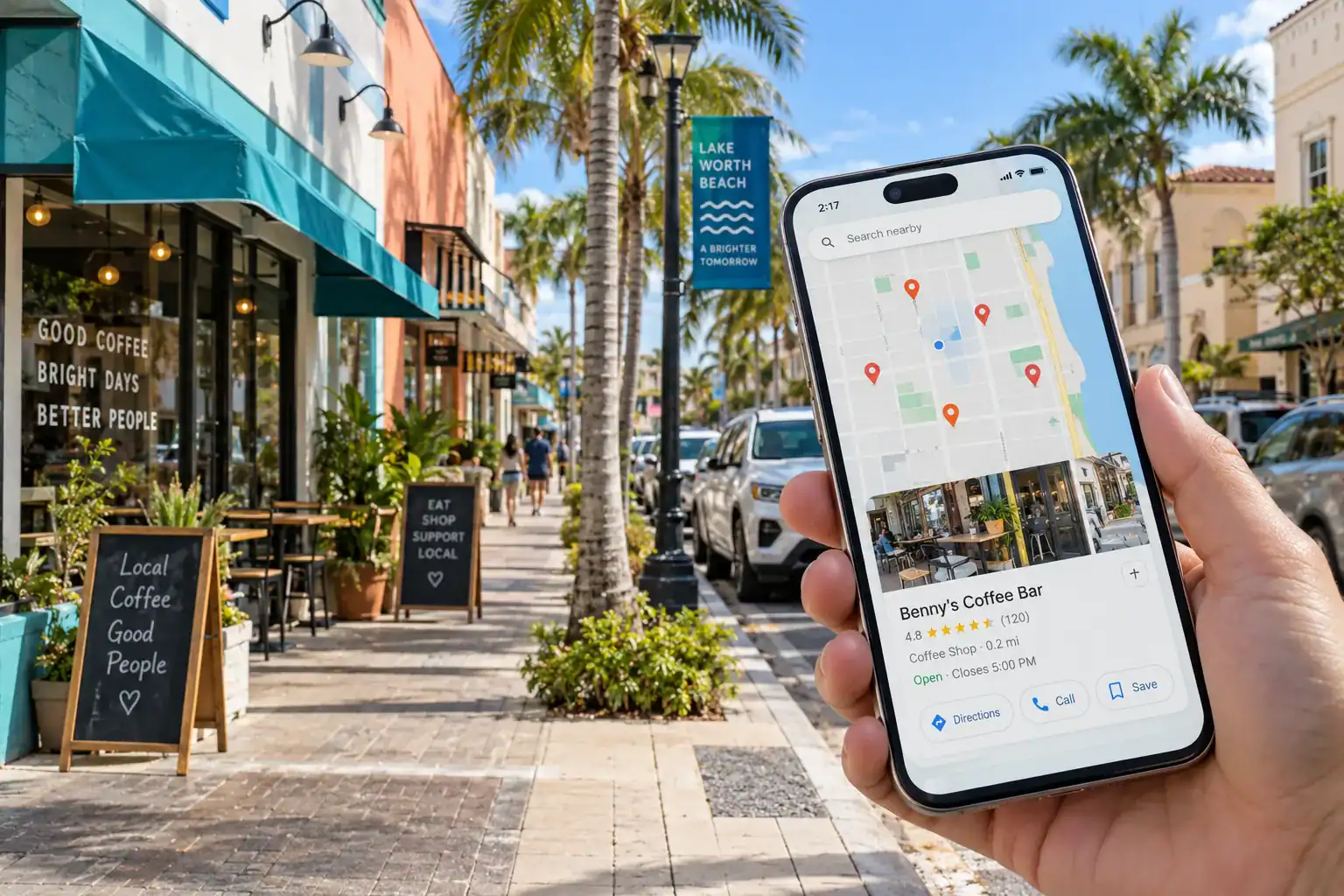
Local business discovery through a map listing in downtown Lake Worth Beach

Home   /   Digital Trends   /   Google Maps Optimization

LOCAL SEARCH + GOOGLE BUSINESS PROFILE

Google Maps SEO
for Local Visibility

A strong Google Business Profile helps nearby customers understand, trust, and act on a local business. The work connects accurate profile details with the website and real customer experience.

Written and technically reviewed by Maarit Durity
Published Mar. 5, 2026 · 19-minute read

THE SHORT ANSWER

What Google Maps listing optimization means

Google Maps listing optimization is the process of making a Google Business Profile accurate, complete, relevant, trustworthy and useful to nearby customers. It includes choosing the correct business category, maintaining reliable contact and location information, describing services clearly, publishing authentic photos, earning legitimate reviews and connecting the profile to a strong local website.

The official product name is Google Business Profile, although many business owners still call it a Google Maps listing, Google business listing or Google My Business listing. The profile can appear in Google Maps, the local results shown in Google Search and branded search results.

Optimization does not mean adding a city and a list of services to the business name, creating profiles at virtual offices or buying reviews. Those tactics can violate Google’s rules and place the visibility of the entire profile at risk.

The practical goal is straightforward: help Google understand exactly what the business is, where it legitimately operates and why it is a relevant choice—then help the customer feel confident enough to call, visit, book or continue to the website.

How Google determines local rankings

Google says local results are mainly based on relevance, distance and prominence. It also says there is no way to request or pay for a better local ranking. See Google’s current guidance on improving local rankings.

Relevance

Relevance is how closely a Business Profile matches what a person is searching for. Accurate categories, services, business information and website content help Google understand that match.

A family dentist and an oral surgeon may both work in dentistry, but they should not use the same primary category unless it truthfully represents the main business. A contractor who installs roofs should not select unrelated categories merely because those categories receive search volume.

Distance

Distance is how far the business is from the person searching, or from the location Google associates with the search. This is why two people can enter the same phrase from different neighborhoods and see different businesses.

No profile edit can eliminate geography. Adding a city to a service area, description or post does not move the business closer to a searcher in that city.

Prominence

Prominence is how well known the business appears to be. Google specifically mentions links to the business, review count and positive ratings as information that may contribute. Prominence can also reflect the broader authority and recognition of a business across the web.

These factors work together. A well-known company may still be too far away for a particular search. A nearby company may be a weak match for the requested service. A perfectly completed profile may still face competitors with stronger relevance, reputation, websites and local recognition.

A four-part Google Maps optimization framework

SoFloWeb evaluates a local presence through four connected layers.

A profile can fail at any one of these layers. Accurate information without useful service details may limit relevance. Optimized categories without proof may not build customer confidence. Strong reviews will not protect a profile that violates eligibility rules. A well-built listing can deteriorate when no one monitors it.

Work through these points in order:

  1. Accuracy: The profile represents a real, eligible business with correct ownership, name, location, phone number, hours and service area.
  2. Relevance: Categories, services, website pages and customer-facing information align with the searches that matter to the business.
  3. Proof: Reviews, original photos, local references, links, credentials and website content support the claims the business makes.
  4. Maintenance: The profile is monitored for suggested edits, inaccurate information, review activity, changing hours, rejected content and performance trends.

Claim and verify the correct Business Profile

Before optimizing anything, confirm that the business controls the correct profile. Search Google Maps for the business name, old names, address and phone number. Look for duplicate, unclaimed or former-location profiles before creating another one.

Google advises businesses to maintain only one profile per real-world location, with limited exceptions for eligible departments and individual practitioners. Duplicate profiles can divide reviews, confuse customers and create management problems.

The owner should retain primary ownership through a company-controlled account. Employees and agencies can be added with appropriate access instead of sharing passwords. This makes it easier to remove former vendors without losing the business’s profile.

Verification confirms that the person managing the profile is authorized to represent the business. It does not guarantee rankings, but an unverified owner has limited control and may be unable to publish or manage important information.

The same ownership principle applies across the digital presence. See Who Should Own Your Website and Marketing Accounts? for the recommended structure for Business Profile, Search Console, analytics, hosting, and advertising access.

Local visibility depends on four connected layers
PROFILEAccurate business information

Categories, hours, address or service area, contact details, services, attributes, and current photos.
WEBSITEA relevant local destination

Service and location content should confirm what the business does and where it legitimately works.

REPUTATIONReal customer evidence

Authentic reviews, thoughtful responses, photos, mentions, and consistent information build confidence.

MEASUREMENTActions that matter to the business

Track calls, directions, website visits, bookings, qualified leads, and changes in local query visibility.

Use the real business name without keyword stuffing

The Business Profile name should match the name customers see in the real world on signage, the website, stationery and other branding. Google’s business representation guidelines prohibit adding unnecessary services, locations, taglines, hours, phone numbers or promotional language to the name.

If the real business name is “Coastal Air,” the profile should not become “Coastal Air Best AC Repair Fort Lauderdale Emergency HVAC” simply because those words describe desired searches.

Keyword-stuffed names sometimes appear to perform well temporarily. That does not make the tactic safe or appropriate. Competitors and users can suggest corrections, Google can change the name, and serious violations can contribute to a suspension. A ranking gained through misrepresentation is not a stable business asset.

THE PROFILE SUPPORTS A DECISION

Hours, photos, reviews, directions, and a clear next step help turn local visibility into a real customer action.

Google Business Profile customer actions for a South Florida restaurant

Choose the most accurate primary category

The primary category should complete the sentence, “This business is a…” It should describe the business itself, not every service it offers.

Google recommends choosing the most specific category that accurately represents the core business and using as few additional categories as necessary. The primary category deserves careful attention because it strongly defines what the profile represents. Additional categories can cover meaningful secondary business types, but they should not be used as a keyword collection.

Categories can change over time, and available options may vary. Review them periodically, but do not switch the primary category repeatedly to chase short-term ranking movement.

For example:

  • A company whose central business is repairing air-conditioning systems may choose an air-conditioning repair category rather than a general contractor category.
  • A dental practice should choose the category that best represents its primary practice, then add legitimate specialties only when those services are actually offered.
  • A restaurant with an ATM should not add an ATM category because the machine is an amenity, not a separate business.

Set the address and service area correctly

Google distinguishes among storefront, service-area and hybrid businesses.

A service-area business operating from a home should hide the address from the public. A business should not show a virtual office, rented mailbox or unstaffed coworking address as though customers can visit it. Google states that a coworking office must have clear signage, receive customers during opening hours and be staffed by the business during those hours to qualify.

Google currently allows service areas to be entered by city, postal code or another supported area, with up to 20 service areas. Its service-area guidance says the overall boundary generally should not extend beyond roughly two hours of driving time from the business base, although some businesses may warrant a larger area.

Review the following factors:

  • A storefront business receives customers at its stated location during its business hours.
  • A service-area business travels to customers and does not serve them at its address.
  • A hybrid business serves customers at a staffed location and also travels or delivers to customers.

Service areas do not create rankings in every selected city

Adding 20 cities does not make the company equally competitive across all 20. The setting tells customers where the business operates; it does not create 20 physical locations or cancel Google’s distance factor.

Businesses that want stronger visibility in multiple cities need a legitimate strategy involving actual service demand, useful location-specific website content, local proof, reputation and—where the business truly operates staffed locations—properly eligible profiles. Doorway pages that merely swap city names are not a substitute.

Complete the customer information that affects decisions

Complete information helps Google match the profile to relevant searches and prevents customers from abandoning the business because they cannot confirm a basic detail.

Hours should describe when customers can actually receive the stated service. Do not list a business as open 24 hours merely because a voicemail, answering service or online form is available around the clock.

Use special hours for holidays and temporary schedule changes. Incorrect “open now” information can waste a customer’s trip and lead to poor reviews that no amount of keyword editing can repair.

Review the following fields carefully:

  • Main and special business hours
  • Holiday hours
  • Local phone number controlled by the business
  • Website and appointment links
  • Business description
  • Opening date
  • Services, menus or products when available
  • Relevant business attributes
  • Accessibility information
  • Booking, ordering or reservation options

Write a useful business description

The business description should help a potential customer understand the company. Explain what the business does, whom it serves, what distinguishes its approach and how long it has operated when that information is accurate and relevant.

Avoid turning the description into a string of cities and keywords. Google’s rules prohibit links in the description and restrict promotional content such as sales offers and prices. A natural description is more persuasive and less likely to be rejected.

The description is not the place for unverifiable claims such as “number one,” “best” or “highest rated” unless the company can clearly substantiate exactly what those terms mean.

A useful description might cover:

  • The primary service or product category
  • Important specialties
  • The legitimate service region
  • Relevant experience or credentials
  • A concise statement about the customer experience

Add services that match real customer needs

For eligible categories, services can be selected from Google’s suggestions or added as custom services. Google says a service may be highlighted when a local customer searches for an offering the business provides. Its services documentation also allows details such as descriptions and prices where available.

Use the service editor to reflect what customers can genuinely purchase or schedule. Organize services logically and use plain language. Do not invent services to capture unrelated searches, and do not paste a list of cities into service names.

The profile and website should support each other. If “commercial roof repair” is an important service, the profile can identify it and the website should have a substantial page explaining the service, process, qualifications, service area and next step. A field in a listing cannot replace the depth and authority of a useful webpage.

Connect the profile to the right website page

The website link should lead to the official page that best represents that location. A single-location business will often use the homepage or a strong local landing page. A multi-location company should generally send each profile to the corresponding location page rather than routing every listing to a generic homepage.

Google explains that Business Profile information can be compiled from owner submissions, the official website, third parties and user contributions. See how Google sources local business information. Consistent facts across these sources reduce ambiguity, but repeating the exact same keyword phrase across every directory is not a ranking strategy.

Use LocalBusiness structured data when it accurately describes information visible on the page. Google’s LocalBusiness structured data documentation explains how businesses can identify details such as location, hours, phone number and business type. Schema helps systems understand information; it does not guarantee local rankings or a particular search display.

That page should make the business information easy to confirm:

  • The same real-world business name
  • Correct address or service-area explanation
  • A direct local phone number
  • Current hours
  • Services offered at or from that location
  • Original local photographs
  • Licensing, credentials and responsible personnel where relevant
  • Directions, parking or arrival information for storefronts
  • A clear method to call, book or request service

Publish real photos that help customers choose

Original photos can show that the business exists, help customers recognize a location, demonstrate completed work and reduce uncertainty about what to expect.

Google’s photo and video guidelines recommend clear, well-lit images that represent reality without significant alteration or excessive filtering. The current guidance lists JPG or PNG images between 10 KB and 5 MB, with a recommended resolution of 720 by 720 pixels.

Photos can improve the usefulness and persuasiveness of a profile. Google does not state that uploading a particular number of photos guarantees a ranking increase. Treat media as customer evidence, not as a ritual performed for an algorithm.

Useful images may include:

  • Exterior views and permanent signage
  • Interior and customer areas
  • Team members at work with appropriate permission
  • Products, equipment or vehicles
  • Completed projects with customer privacy protected
  • Accessibility, parking and entrance details
  • Before-and-after examples that are truthful and properly authorized

Build an ethical review system

Reviews help customers evaluate a business, and Google states that review count and positive ratings can help local ranking. The safest long-term strategy is to make review requests a normal part of serving real customers.

Google’s fake engagement policy prohibits paid reviews, review incentives, reviews that do not reflect genuine experiences and selectively soliciting positive reviews while discouraging negative ones. Google may remove reviews, restrict new reviews, unpublish existing ratings or display a warning when it determines that a business has violated its rules.

The Federal Trade Commission’s Consumer Reviews and Testimonials Rule also addresses fake reviews, sentiment-conditioned incentives and review suppression. A reputation company does not make prohibited activity safe merely because the business outsourced it.

A responsible process includes:

  1. Ask customers after a genuine transaction or service experience.
  2. Make the request easy with Google’s review link or QR code.
  3. Ask for honest feedback without telling the customer what rating to leave.
  4. Send the request consistently rather than only to customers expected to be happy.
  5. Respond professionally to both positive and negative reviews.
  6. Protect private information when writing a public response.
  7. Report reviews only when they violate policy, not merely because they are unfavorable.

Review responses should sound like a responsible business

A useful response thanks the reviewer, addresses the substance when appropriate and shows future readers how the company communicates. Do not expose private customer details or argue about confidential facts in public.

For a negative review, acknowledge the concern without admitting something unverified, invite an appropriate private conversation and explain any corrective step the business can responsibly disclose. The response is written for every future customer who may read it—not only for the original reviewer.

Use posts for timely customer communication

Google Business Profile posts can share updates, events and offers on Search and Maps. They are useful for current information such as a seasonal service, community event, new product, schedule change or educational resource.

Posts should serve a real customer purpose and lead to a relevant page. Google’s post documentation says posts are reviewed and may be marked live, pending or not approved. It also notes that posts older than six months are generally archived unless a date range is set.

Google does not identify posting frequency as one of its stated local ranking factors. Posts can improve freshness, communication and conversion without being treated as a guaranteed ranking lever.

Strengthen prominence beyond the profile

The Business Profile is one part of local SEO. Prominence develops through the company’s broader presence and reputation.

Buying large packages of low-quality directory listings is not the same as becoming prominent. A few credible local and industry references can be more meaningful than hundreds of copied listings on sites no customer uses.

Depending on the business, that work may include:

  • Useful service and location pages
  • Local news or trade coverage earned through real work
  • Links from professional organizations and community partners
  • Accurate licensing and association profiles
  • Sponsorships and involvement that create legitimate local references
  • Original research, guides or resources worth citing
  • Consistent contact and location information on important platforms
  • Reviews on relevant industry and consumer sites

Optimize multiple locations without creating duplicates

Each legitimate location should have its own accurate profile and a corresponding website page. The location must satisfy Google’s real-world requirements; a rented address alone does not create eligibility.

Google has separate rules for chains, departments and public-facing individual practitioners. A hospital department, attorney, doctor or real-estate professional should confirm eligibility before creating additional profiles. More listings are not automatically better.

For multiple locations:

  • Keep brand naming consistent unless the real-world branding differs.
  • Use the same appropriate primary category when locations perform the same core function.
  • Provide the actual phone number, hours and details for each location.
  • Link to a unique location page with useful local information.
  • Use original photos from that location.
  • Monitor reviews and edits separately.
  • Avoid copying the same city-swapped paragraph across every page.

Avoid shortcuts that can damage the profile

Google can reject edits, remove content, restrict a profile or suspend it. Recovery can require business documentation and may interrupt calls and leads while the issue is reviewed. The safer strategy is to build visibility the business can defend with real-world evidence.

Some local optimization offers are built around tactics that misrepresent the business. Warning signs include:

  • Adding services and cities to the business name
  • Using a PO box, mailbox, virtual office or unstaffed location
  • Creating profiles for cities where the business has no eligible location
  • Producing duplicate profiles for the same business
  • Buying, trading or fabricating reviews
  • Asking only happy customers for reviews
  • Paying for five-star reviews or offering a discount in exchange
  • Selecting irrelevant categories
  • Listing false 24-hour availability
  • Using someone else’s images or heavily altered images as evidence of work
  • Making constant core-field edits without a business reason
  • Giving an agency primary ownership without retaining company access

Google Maps optimization and AI search visibility

Local discovery is expanding beyond a fixed list of map results. Search systems can assemble answers about nearby businesses, compare service information and summarize reviews or other public information.

Google says local profile information can come from business owners, official websites, licensed third parties, users and Google’s own interactions with a place. When these sources conflict, a search or AI system has a harder job determining which fact is current. Consistency cannot force an AI citation, but it can make the business easier to understand and describe accurately.

There is no special field that guarantees inclusion in an AI answer. The useful work remains familiar:

  • Maintain accurate Business Profile information.
  • Publish a website that clearly explains services, locations and qualifications.
  • Keep entity details consistent across credible sources.
  • Earn genuine customer feedback and independent references.
  • Use original photos and firsthand business information.
  • Answer important local customer questions directly.
  • Correct outdated hours, services and contact information promptly.

Measure actions instead of watching one ranking

One manual search from the business owner’s phone is not a reliable ranking report. Local results change with the searcher’s location, query, device and context. A business needs a broader view.

Google Business Profile performance can report customer actions such as profile views, direction requests, call-button clicks, website clicks and eligible bookings. Google explains the current measurements in its Business Profile performance documentation.

Add campaign parameters to the website URL so analytics can distinguish Business Profile traffic from other organic visits. Document major changes to categories, landing pages, hours and service information so performance shifts can be evaluated against an accurate timeline.

Grid-based local rank tracking can show how visibility changes across a service area, but rankings remain a diagnostic measure. A larger green map is not the business goal. Qualified calls, appointments, visits and revenue matter more.

Track profile data alongside:

  • Qualified calls and call outcomes
  • Form submissions and booked appointments
  • Website sessions from the profile
  • Leads by service and location
  • Revenue or completed jobs where tracking permits
  • Review volume, rating patterns and response time
  • Branded and non-branded Search Console queries
  • Conversion rate on the connected landing page
  • Incorrect edits, rejected updates and profile interruptions

A monthly Google Business Profile maintenance checklist

Every week

Weekly checks protect the listing from visible errors that can interrupt calls, directions, bookings, or customer trust. New feedback and public edits should be reviewed while the details are still current. Small issues are easier to correct before they persist across several weeks of customer activity.

Review the work and evidence expected during this stage:

  • Review new customer feedback and respond appropriately.
  • Check for unexpected public edits or incorrect information.
  • Confirm that the website, phone and booking links work.
  • Upload useful current photos when the business has something real to show.

Every month

Monthly review connects profile activity with the leads and completed business the company actually received. Categories, services, hours, and the linked landing page should still match current operations. This cadence is frequent enough to catch drift without treating every minor fluctuation as a strategy change.

Review the work and evidence expected during this stage:

  • Review calls, website clicks, directions and bookings.
  • Compare customer actions with leads and completed business.
  • Check categories, services, attributes and hours for accuracy.
  • Review the connected landing page for outdated information.
  • Publish a meaningful update when there is timely information to share.
  • Record important changes in the reporting timeline.

Every quarter

Quarterly review is the time to look beyond routine responses and examine the profile’s broader accuracy and competitive condition. Duplicate listings, former locations, third-party conflicts, and aging media can accumulate quietly. A deeper review keeps the public record aligned with the business as it changes.

Review the work and evidence expected during this stage:

  • Reevaluate category and service alignment.
  • Audit duplicate and former-location profiles.
  • Check important third-party listings for factual conflicts.
  • Review the quality and recency of location photos.
  • Compare local visibility across target areas and services.
  • Identify questions from calls and reviews that the website should answer.

When the business changes

Update the profile carefully when the business moves, changes its name, changes ownership, closes temporarily, adds a staffed location or substantially changes its primary service. Major edits can trigger reverification. Preserve documents, signage photographs and other evidence before submitting a change.

When a business should hire a Google Maps optimization agency

An agency should be able to explain what it will change, why the change is allowed and how success will be measured. It should not promise the number-one position, sell guaranteed placement in the local three-pack or hide behind a proprietary account the business does not control.

A confident promise is not a substitute for a defined deliverable, named owner, and practical handoff path.

A business may benefit from experienced help when:

  • The profile has been suspended or repeatedly reverified.
  • A move, rebrand, merger or ownership change created conflicting listings.
  • Multiple practitioners or departments create eligibility questions.
  • The company manages many locations.
  • Rankings and leads declined after major profile or website changes.
  • The profile receives views but few qualified calls or bookings.
  • The business lacks reliable local SEO measurement.
  • A previous provider used risky names, addresses, categories or reviews.

The SoFloWeb perspective

Google Maps optimization works best when the Business Profile and website tell the same truthful, detailed story. The profile can create immediate visibility and actions, while the website provides the depth needed to explain services, demonstrate experience and convert a cautious visitor.

SoFloWeb does not treat the listing as a collection of fields to fill once and forget. We examine eligibility, accuracy, search relevance, website alignment, reviews, local proof, conversion paths and ongoing maintenance. We also distinguish between an action that may help a customer and a factor Google has actually said influences local rankings.

No ethical agency controls Google’s local results. What an experienced team can control is the quality of the information, the strength of the connected website, the evidence supporting the business and the discipline used to monitor performance.

PRACTICAL QUESTIONS

Google Maps and Business Profile Questions

Useful answers about categories, service areas, reviews, photos, suspensions, local rankings, and the connection between a Business Profile and its website.

CLEAR ANSWERS, USEFUL CONTEXT

These answers summarize the most common follow-up questions without replacing the details and qualifications explained throughout the article.

READ THE FULL ANSWER BEFORE MAKING THE DECISION

Yes. Eligible businesses can add or claim a Google Business Profile at no charge. A business may still invest in professional optimization, website development, photography, local SEO or advertising, but payment is not required to create the profile.

No. Google states that there is no way to request or pay for a better local ranking. Advertising can create paid visibility, but it does not purchase a higher organic local position.

Accurate edits may appear quickly or require review, while competitive visibility can take longer to change. Timing depends on verification, the type of edit, location, competition, website strength, reputation and Google’s systems. No responsible provider can guarantee a date or position.

Google says review count and positive ratings can help local ranking. Reviews also influence customer decisions. They are one part of prominence, not a guarantee that a business will outrank closer or more relevant competitors.

Google presents posts as a way to share timely information and help customers decide what to do. It does not identify posting frequency as a stated local ranking factor. Use posts for customers and conversions, not as a promise of ranking gains.

Adding accurate service areas helps customers understand where the business operates. It does not create a physical location in every selected city or eliminate Google’s distance factor.

Only when those words are part of the genuine, consistently used real-world business name. Adding services or cities solely for ranking can violate Google’s guidelines and place the profile at risk.

An eligible service-area business can operate from a home, but it should hide the address when customers are not served there. It can display the legitimate areas where it travels to customers.

No. Business Profile optimization is an important part of local SEO. A complete strategy also includes the website, technical SEO, location and service content, links, citations, reputation, structured data, measurement and local authority.

No. Local results depend on factors including relevance, distance and prominence, and they vary by searcher and query. An agency can improve the business’s information and competitive foundation, but it cannot ethically guarantee a position it does not control.

Maarit Durity, owner of SoFloWeb

AUTHOR + TECHNICAL REVIEW

Maarit Durity

Owner, website strategist, designer, developer, SEO practitioner, and content strategist at SoFloWeb.

Maarit has worked in websites and digital marketing for more than 25 years. She writes from direct experience planning, building, rebuilding, optimizing, and measuring business websites—and takes responsibility for the technical review of this article.

Learn more about SoFloWeb and Maarit’s experience →