
We improve the technical, content, and business signals that help AI-driven search systems understand and verify a website. Because inclusion is never guaranteed, every recommendation is grounded in sound SEO, evidence, and practical improvements.

Select an available 45-minute window, then tell us how to reach you. We will confirm the appointment and send the Google Meet details after reviewing the request.
45-minute video call. Times shown are Eastern. At least one day’s notice is required. Faded blocks are unavailable.
Share the same project details requested on our homepage in two short steps. We will review the information and respond using the communication method you select.
Tell us what the business needs, what is changing, and which services you are considering. We will review the details before recommending the clearest practical next step.
We improve the technical, content, and business signals that help AI-driven search systems understand and verify a website. Because inclusion is never guaranteed, every recommendation is grounded in sound SEO, evidence, and practical improvements.
AI-generated answers draw from changing search indexes, websites, business profiles, publications, directories, and other sources. We improve the parts of that foundation a business can control: technical access, clear service information, original content, consistent facts, structured data, and credible supporting sources. No provider can force an outside platform to cite, mention, or recommend a specific page.
AI search visibility work is still developing. The platforms change quickly, source selection is not fully transparent, and a result seen today may look different tomorrow. This is not a guaranteed-placement service or a promise that every optimized page will appear in an AI answer.
We start with the business, the customers it needs to reach, the condition of the current website, and the questions people ask while discovering and comparing providers. We research current answers, competitors, citations, and source patterns; inspect technical access and existing search equity; identify missing or conflicting information; and recommend work that has a sound reason behind it.
In some cases, our work has been followed by stronger visibility or inclusion in AI answers. Those successes are useful evidence, but they are not a promise that the same result will occur for every business, question, or platform. We implement approved improvements carefully and monitor what follows so recommendations can change with the evidence.
We identify the questions customers ask while discovering a category, comparing options, checking qualifications, evaluating a location, and deciding what to do next—not just the short phrases already visible in keyword tools.
We test the business, its services, important topics, and relevant local queries across major AI experiences to establish what is mentioned, omitted, misstated, or attributed to someone else.
AI answers may rely on search results, business profiles, authoritative publications, directories, reviews, public records, videos, and other websites. We examine the actual source patterns rather than assuming every engine works the same way.
When a business lacks clear service details, firsthand explanation, location context, authorship, supporting proof, or consistent public information, the gap must be addressed accurately—not filled with generic generated copy.
Every engagement is scoped around the client’s current visibility, business priorities, website condition, audience, market, and competitive evidence. Some businesses need technical corrections or clearer priority pages; others first need stronger traditional SEO, more complete business information, or better supporting sources. You receive explained priorities and hands-on implementation without a claim that any one change will secure an AI citation.
What you receive: a documented baseline showing how the business appears across priority AI systems, which questions trigger relevant answers, where the company is mentioned or omitted, which sources are cited, and which inaccuracies need attention.
What you receive: research into the competitors repeatedly surfaced for valuable questions, the pages and third-party sources supporting those answers, the gaps they cover well, and the opportunities that make sense for your business.
What you receive: a technical review and approved corrections for crawling, indexation, robots controls, rendering, canonicals, sitemaps, internal links, important text, OpenAI search-crawler access, and other barriers that can prevent retrieval.
What you receive: clearer relationships among the company, services, products, people, locations, industries, credentials, and areas served—implemented where those facts need to appear and reconciled with trustworthy public sources.
What you receive: researched, human-reviewed improvements to priority pages, direct answers, comparisons, process explanations, authorship, supporting proof, and new content only where a genuine information gap exists.
What you receive: appropriate schema that matches visible content, stronger source and internal-link relationships, an optional llms.txt file when it has a real purpose, baseline reporting, and a practical plan for retesting and refinement.

Answer Engine Optimization and GEO do not replace traditional SEO. Google’s AI features draw from its search index and ranking systems, while other assistants also rely on searchable, crawlable, and corroborated information from the open web.
Existing rankings, useful pages, internal links, metadata, local profiles, reviews, and earned authority therefore remain valuable. Our SEO services establish and protect those fundamentals.
AI-focused work extends that foundation by examining generated answers, source selection, entity consistency, conversational questions, citations, and the ways a business is compared or recommended. There is no responsible shortcut around the fundamentals.
Important pages must be accessible, indexable, internally linked, technically stable, and eligible to appear in search. Blocking a crawler or hiding essential information inside an inaccessible experience can remove the evidence an answer engine needs.
Systems need to understand what the company offers, which customers it serves, how products or services relate, where the business operates, and which page is the best source for each subject.
Firsthand explanations, original research, experienced recommendations, accurate examples, and useful detail give an engine something distinctive to retrieve. Commodity text that restates common advice rarely creates a strong reason to cite the source.
Business profiles, trusted directories, professional organizations, customer reviews, publications, interviews, and other credible references can reinforce—or contradict—what the website says. Consistency matters, but fabricated mentions do not belong in a legitimate strategy.
We compare baseline and follow-up answers, citations, brand mentions, referral traffic, Search Console visibility, analytics behavior, leads, calls, and real business outcomes. One manually checked prompt is not a complete measurement system.
Research, content, technical implementation, and quality checks are coordinated around one documented plan. We use supporting help where it strengthens the work, review recommendations in context, and remain accountable for every approved change.
We learn how the company earns revenue, what customers ask, which offerings matter, where it operates, and what claims can be supported. Existing Search Console and analytics evidence is reviewed when available without requiring access to unrelated accounts.
We build a practical prompt set around discovery, comparison, evaluation, local intent, branded questions, and purchase or contact decisions, then document the competitors, citations, source types, omissions, and inaccurate statements appearing today.
We inspect crawling, indexing, rendering, page relationships, structured data, business profiles, important third-party sources, and the clarity of service, product, location, and organization information.
Approved recommendations become practical website improvements: clearer priority pages, original human-reviewed content, direct answers, internal links, entity details, source references, appropriate schema, image metadata, and technical corrections.
New and revised pages are checked for accuracy, mobile presentation, accessibility, crawlability, schema validity, indexation readiness, links, and consistency with the public facts a customer or answer engine can verify.
We retest meaningful questions, watch citations and mentions over time, review Search Console and analytics evidence, identify changes in source patterns, and refine the work based on what improves—not on a rigid checklist.
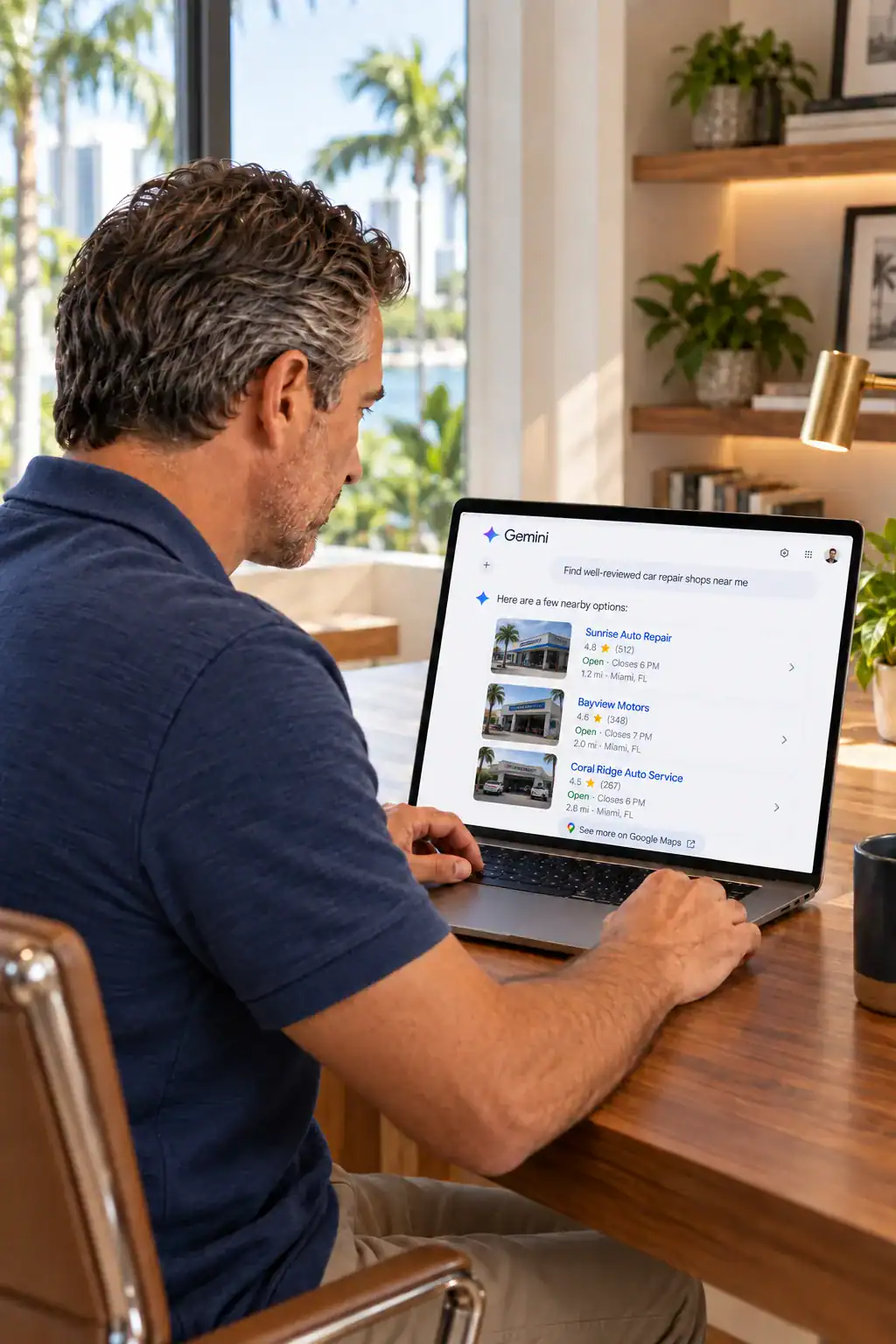
People rarely make an important choice after asking one question. They refine what they need, compare alternatives, add a location, test qualifications, and look for details that reduce uncertainty.
We build realistic question paths around the way customers move from early research to a shortlist and a final decision. Those paths include branded and unbranded questions, local qualifiers, follow-up prompts, and the practical concerns that appear later in the process.
This work helps reveal where a website answers the first question but leaves the next one unresolved. We use those gaps to prioritize clearer service details, proof, location context, and decision-making information that benefits both prospective customers and the systems interpreting the site.
The same business can be described differently in Google AI Mode, ChatGPT Search, Gemini, Perplexity, Copilot, Claude, and Muse because each experience retrieves, weighs, and presents sources differently. We document those differences, identify information and access problems that can be addressed, and recommend improvements to the underlying web presence. That work can improve readiness and support visibility, but it cannot control the answer an outside system ultimately generates.
Platform research is tied to questions customers actually ask while learning about a problem, finding a provider, comparing services or products, checking qualifications, evaluating a location, and deciding what to do next. The goal is accurate, useful representation during a real decision—not a vanity mention or an unsupported promise.
We review how a business appears in Google AI Overviews and AI Mode, then address relevant SEO, indexable-content, Business Profile, entity, and original-content issues those experiences may rely on.
We test branded, non-branded, comparison, and follow-up questions in ChatGPT Search; review visible sources and crawler access; and strengthen website information that may support accurate mentions. ChatGPT still decides what to retrieve and present.
Perplexity emphasizes cited web research, while Copilot connects conversational answers with Microsoft’s search ecosystem. We compare visible source patterns and correct practical gaps affecting access, consistency, and verification without assuming a change will produce a citation.
Gemini, Claude, and the newly launched Meta Muse can matter for different audiences and research behaviors. We monitor relevance and test meaningful customer questions, then expand work only when the available evidence supports it.
A business owner can open an AI tool, create a draft, summarize research, or generate recommendations in minutes. Those capabilities are useful. They do not automatically supply business context, verification, search history, technical judgment, risk assessment, or careful implementation on a working website.
AI can organize notes, produce a first draft, suggest questions, compare formats, and reduce repetitive work. We use appropriate tools where they improve efficiency, then review the output against the business, the evidence, and the consequences of publishing it.
A generated page can sound polished while repeating information already found everywhere, misstating a service, flattening local differences, inventing certainty, or creating pages that compete with one another. More text is not the same as more authority.
Experienced work connects search data, customer behavior, competitive context, technical constraints, business priorities, and risk. It recognizes when an automated recommendation is helpful, irrelevant, outdated, or likely to cause damage.
The value is not simply knowing which button to press. It is knowing what question to investigate, which evidence to trust, how the parts of the website relate, what should remain unchanged, and what implementation will improve the whole system.
Changing URLs, consolidating pages, rewriting proven content, opening crawler access, adding schema, or publishing location claims can affect rankings, compliance, credibility, and customer expectations. Those decisions deserve informed review.
We document the reason for a recommendation, protect useful existing equity, validate visible facts, implement approved work carefully, and measure the outcome. The client receives accountable professional judgment—not a raw export from an automated tool.

Firsthand knowledge of South Florida helps us evaluate how AI answers describe businesses serving coastal communities, downtown districts, western suburbs, rural and equestrian markets, industrial corridors, tourism and hospitality areas, marine industries, and year-round residential markets.
A person asking for a service in Palm Beach County may mean something different from a visitor comparing providers in Broward, a company searching across Miami-Dade, or a resident in Martin or Monroe County. Distance, traffic patterns, language, seasonality, neighborhood identity, service areas, and customer expectations affect what a useful answer should explain.
Accurate regional context also reduces wasted visibility. A business is better served by being associated with the communities, service conditions, and customer needs it can actually support than with broad location claims that attract the wrong inquiries. Clear geographic boundaries help answer engines provide more useful context and help qualified prospects reach an appropriate provider.
Our SoFlo SEO approach combines search evidence with regional knowledge. For AI search, that means building accurate relationships among the company, its offerings, its actual service area, and the South Florida markets where customers make decisions—without publishing shallow city lists or pretending every community behaves the same way.
These answers explain what the service does, which platforms matter, how the terminology fits together, and where responsible optimization ends.
AI search is evolving quickly and outcomes are uncertain. The practical goal is to give people and systems accurate, useful, accessible information supported by trustworthy evidence—then measure what changes without treating visibility as guaranteed.
AI Search Optimization is research, technical, content, entity, and source work designed to make a business easier for AI-powered search and answer engines to access, understand, and verify. It can strengthen eligibility and the information available to those systems, but it cannot guarantee that a platform will cite, mention, or recommend the business.
These terms overlap. Answer Engine Optimization (AEO) focuses on direct answers. Generative Engine Optimization (GEO) focuses on visibility in generated responses. AI SEO and AI Search Optimization are broader plain-language terms. AI Optimization (AIO) and Large Language Model Optimization (LLMO) are also used for work intended to improve how AI systems interpret and surface a business. We treat them as related parts of one practical visibility service instead of selling each acronym as a disconnected product.
No. AI search is new, changes quickly, and is controlled by outside platforms. Models, indexes, visible sources, location context, wording, and interfaces can all change the result. SoFloWeb has seen successful visibility outcomes, but those results are evidence of what can happen—not a guarantee for another business, question, or platform. The service improves what can responsibly be controlled and measures what follows.
Research commonly includes Google AI Overviews and AI Mode, ChatGPT Search, Gemini, Perplexity, Microsoft Copilot and Bing, Claude, and Meta Muse. The right mix depends on the audience and business. We establish a baseline, studies visible sources and access issues, implements justified improvements, and retests meaningful customer questions without claiming control over any platform’s answer.
No. Traditional SEO remains the foundation. Google’s AI search features use its search index and ranking systems, and other answer engines also depend on crawlable pages, accessible information, credible sources, and consistent entities. AI-focused work adds prompt research, answer analysis, citation patterns, conversational intent, crawler review, and cross-platform measurement to established SEO.
llms.txt is an emerging, voluntary text file intended to point language-model tools toward selected website resources. It may be useful as documentation for some sites and tools, but it is not a universal ranking file, major answer engines do not all rely on it, and Google does not require it for AI Overviews or AI Mode. We may add it when there is a clear purpose, but it never replaces crawlable pages, internal links, structured data, accurate business information, or strong content.
You can use AI to brainstorm, organize information, summarize notes, or create a starting draft. The risk is publishing material that sounds confident but lacks firsthand detail, repeats common information, misunderstands the business, invents facts, or weakens pages that already perform. We add research, interviewing, verification, editorial judgment, search context, information architecture, and careful implementation—the parts a prompt cannot supply automatically.
Measurement can include a documented set of buyer questions, brand mentions, citations, answer accuracy, referral traffic, Search Console and analytics evidence when available, engagement, calls, leads, and changes in the sources being surfaced. Results are interpreted cautiously because wording, time, location, device, language, recent activity, and platform behavior can change the order or content of an answer.
Responsible AI visibility work is specific, technically sound, and candid about uncertainty. It strengthens the website and public business information people already rely on, even when an individual answer engine changes its model, sources, or interface. Observed improvements are reported as results, not converted into promises for every future search.
Before changing content, we document current search visibility, AI answers, cited sources, competitor coverage, business priorities, and the pages or rankings worth protecting.
AI can assist with production, but the published work must contain accurate facts, real experience, useful explanation, and deliberate editorial judgment.
Crawler directives, page structure, redirects, canonicals, structured data, internal links, and indexing decisions are changed only when they serve a documented purpose.
Names, services, products, people, credentials, locations, contact details, and areas served are checked for consistency so an engine has reliable facts to compare.
We do not invent reviews, credentials, statistics, partnerships, citations, or third-party mentions. Authority has to be earned and represented truthfully.
Mentions and citations matter, but so do qualified visits, calls, leads, engagement, and the accuracy of the answers customers see. Reporting keeps those outcomes in context.
These genuine Google reviews reflect client experiences with our search knowledge, website work, communication, and support for business visibility. They do not promise placement in AI-generated answers.
We had the best experience working with SoFloWeb. They completely transformed our website, and because of their expertise we’re now showing up on Google search — what a huge difference it has made for our business! From start to finish, they were professional, responsive, and truly amazing to work with. Highly recommend them to anyone looking to elevate their online presence.
One of the best there is for SEO and website design and consulting!
I’m a client of SoFloWeb and can wholeheartedly recommend them to any business owner seeking to improve their google rankings and overall search optimization. Maarit and her team are also extremely hands-on with their clients and really take the time to understand your goals and needs as a customer. I’m a very satisfied customer.
Best experience I’ve had with a SEO company and prompt and reliant! Highly recommend and a great price also!
Let’s discuss how your business currently appears in AI answers, what the website may need, and which improvements are reasonable to test. You will get a candid assessment—not a promise of placement.