VIDEO CALL REQUEST

Choose a Time to Talk

Select an available 45-minute window, then tell us how to reach you. We will confirm the appointment and send the Google Meet details after reviewing the request.

45-minute video call. Times shown are Eastern. At least one day’s notice is required. Faded blocks are unavailable.

START A CONVERSATION

Tell Us What the Business Needs

Share the same project details requested on our homepage in two short steps. We will review the information and respond using the communication method you select.

ABOUT 2 MINUTESTwo focused steps
NO OBLIGATIONA practical first conversation
PERSONALIZED RESPONSEBased on the business and its goals
QUOTE & PROJECT DETAILS

Request a Website & Marketing Proposal

Tell us what the business needs, what is changing, and which services you are considering. We will review the details before recommending the clearest practical next step.

FOUR FOCUSED STEPSAbout 3 minutes
NO OBLIGATIONClear guidance without pressure
PERSONALIZED REVIEWBased on the business and its goals
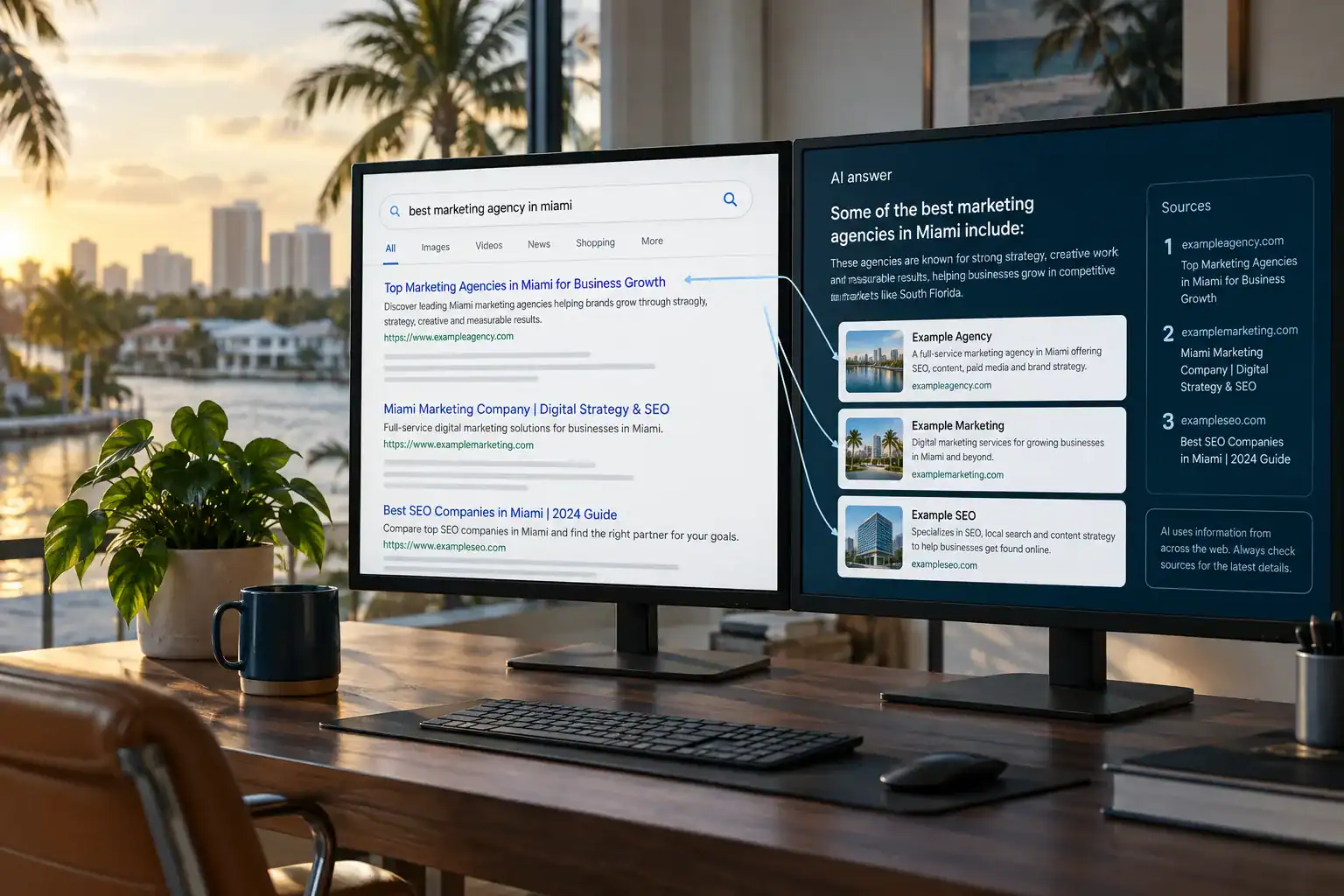
Organic search results connected with cited AI-generated answers

Home   /   Digital Trends   /   How SEO Benefits Business

ORGANIC SEARCH + AI DISCOVERY

SEO Benefits
for Business in AI Search

SEO still connects businesses with people actively looking for answers, services, and products. It also builds the accessible, credible web foundation AI systems need when finding and citing sources.

Written and technically reviewed by Maarit Durity
Published May 7, 2026 · 14-minute read

THE SHORT ANSWER

How does SEO benefit a business?

Search engine optimization helps a business become visible when potential customers search for its services, products, expertise or location. A strong SEO program can attract qualified visitors, support local discovery, build brand familiarity, improve the website experience and create a long-term source of leads that does not disappear each time an advertising campaign stops.

SEO now supports another important opportunity: visibility inside AI-generated answers. Google AI Overviews, AI Mode, Microsoft Copilot and other answer systems use searchable web content to find sources, compare information and support responses. The terminology is expanding—AIO, AEO and GEO are all used—but the foundation remains a technically sound, useful and authoritative website.

Why Is SEO Important for Business?

SEO is important because customers do not limit their searches to a company name. They search for a problem, service, product, comparison, location or question before they know which business they will choose.

A company may already appear when someone searches its exact name. That is branded visibility. Growth often depends on non-branded visibility: appearing when someone searches for “commercial roof repair,” “concierge doctor near me,” “how to remove mold after a leak” or another need the business can solve.

Without SEO, a website may function as an online business card. It confirms that the company exists for people who already know the name, but it may do little to introduce the company to new customers. SEO turns the website into a discoverable business asset.

Google’s Search Essentials recommends creating helpful, reliable content; using the words people use to search; making links crawlable; and ensuring that Google can understand important content, images, video and structured data. Those fundamentals are not merely technical tasks. They determine whether a business can be considered when a customer asks a search engine or AI system for help.

SEO connects a business with people who have a need

Most marketing interrupts someone who may or may not be interested. Search works differently. The customer initiates the conversation.

Someone searching for a service, comparing providers or asking a detailed question is expressing intent. SEO helps the business create the right page for that moment. A service page may reach someone ready to call. A comparison article may assist a person evaluating options. A helpful guide may introduce the company earlier in the decision process.

This does not mean every visitor will become a customer. Search intent must match what the business offers, and the page must make the next step clear. The benefit is that SEO can attract people whose questions or needs already relate to the business.

SEO can produce qualified traffic instead of empty traffic

More website visits are not automatically better. A thousand visitors from irrelevant searches can be less valuable than ten visitors who need the exact service a company provides in its service area.

The content plan should support more than one stage without treating every query as a sales pitch. A useful article can establish knowledge. A detailed service page can explain fit and process. A location page can establish where the company works. Clear conversion paths can then help the right visitor call, book or inquire.

An effective SEO strategy distinguishes among:

  • Informational intent: The person wants to understand a subject or solve a problem.
  • Commercial intent: The person is comparing providers, products, costs or approaches.
  • Transactional intent: The person is ready to schedule, purchase, call or request a quote.
  • Local intent: The person wants an option available in a specific city or nearby area.
  • Branded intent: The person already knows the company or product name.
SEO creates assets that serve search, AI systems, and customers
ACCESSMake important information discoverable

Technical SEO helps search engines and eligible AI systems reach, render, index, and interpret the website.
RELEVANCEAnswer the needs behind the search

Service, location, comparison, and educational pages connect the business to real customer questions.

TRUSTSupport claims with experience and evidence

Clear authorship, accurate sources, reviews, mentions, and original knowledge strengthen credibility.

RESULTSMeasure more than one ranking

Evaluate queries, pages, traffic, leads, revenue, local actions, branded demand, and observed AI citations.

SEO helps local customers discover a business

Local SEO connects website content, business information, reputation and geographic relevance. Google says local results are mainly influenced by relevance, distance and prominence. It also recommends maintaining complete, accurate business information and notes that reviews and links can contribute to prominence. See Google’s guidance on improving local ranking.

Google also explains that local business information may come from the company’s official website, business-owner submissions, third parties and users. Consistency across these sources helps systems understand which business they are describing.

For a local business, an SEO program may include:

  • A complete and properly managed Google Business Profile
  • Consistent name, address, phone and service information
  • Useful service and location pages
  • Original photographs and evidence of completed work
  • Reviews and a responsible review-response process
  • Local links and community references earned through real relationships
  • Accurate hours, categories, services and appointment information
  • LocalBusiness structured data that matches visible information

AI VISIBILITY BUILDS ON A SEARCHABLE WEB

Clear content, crawlability, entity relationships, trustworthy mentions, and measurement support both conventional search and AI discovery.

Click or tap the screenshot to enlarge it.

SEO builds visibility beyond one advertisement

Paid advertising can create immediate visibility, but it generally stops when the budget stops. SEO is slower and less predictable, yet a useful page can continue attracting impressions, visits and leads after its initial production cost.

That does not make organic traffic free. Research, writing, design, development, optimization, monitoring and updates require investment. Rankings can also change as competitors improve and search systems evolve. The practical advantage is that a well-maintained content and technical foundation can continue producing value across many searches and stages of the buying process.

The strongest businesses often use both channels. Advertising can reach immediate demand and test messages. SEO can build durable visibility, improve landing pages and reduce total dependence on paid traffic.

SEO can expand visibility across Bing and DuckDuckGo

Google is the largest search engine, but it is not the only place where people discover businesses and information. Bing operates its own search index and also surfaces website links in web results, chat responses, news answers, images and knowledge panels. Bing’s official Search Performance documentation explains that Bing Webmaster Tools reports impressions and clicks across those surfaces, including links shown in chat responses. Its Recommendations tool evaluates indexed pages against established search-optimization practices to help site owners identify technical and content issues affecting visibility across Microsoft search and AI experiences.

That makes crawl access, indexable pages, unique useful content, accurate page structure, quality references and measurement relevant beyond Google. Bing also recommends IndexNow and other URL-submission methods to notify participating search engines when pages are added, updated or removed. Submission can improve discovery speed, but Bing is clear that it does not guarantee inclusion in results.

DuckDuckGo uses a combination of its own crawler and indexes, specialized sources and partner data. Its official explanation of where DuckDuckGo results come from says that most traditional links and images are largely sourced from Bing, while Instant Answers may draw from other subject-specific sources. A business cannot treat DuckDuckGo as a copy of Google or optimize for it through one isolated trick. The practical takeaway is broader: a technically accessible website with original, credible information and consistent business details can support discovery across multiple search ecosystems rather than depending on one platform.

SEO improves the website visitors actually use

Google’s page experience guidance says its systems consider multiple signals that align with a good experience. Core Web Vitals matter, but perfect performance scores do not guarantee rankings. The purpose of technical improvements should be to make the site easier for people and search systems to use.

Good SEO is not limited to keywords and metadata. It often improves the same elements that determine whether a visitor trusts the website and completes a task:

  • Clear navigation and page hierarchy
  • Descriptive headings
  • Fast, stable mobile pages
  • Accessible text and controls
  • Helpful service explanations
  • Transparent pricing or cost factors where appropriate
  • Visible credentials and firsthand evidence
  • Working forms and phone links
  • Logical internal links
  • Accurate titles and summaries in search results

SEO builds familiarity and trust before the customer calls

A potential customer may encounter a company several times before making contact. The business might appear in a local result, a service search, an article, an image result and an AI-generated answer.

Repeated relevant visibility can create familiarity. Detailed content can also answer the questions people are reluctant to ask on a first call: How does the process work? What affects the cost? What should I prepare? Which option fits my situation? What warning signs should I recognize?

Trust still has to be earned. Rankings are not an endorsement, and a company should not imply that Google guarantees its quality. The website needs verifiable experience, accurate claims, clear authorship, transparent policies, real contact information and evidence that the company does the work it describes.

SEO provides business intelligence

Search data can reveal how customers describe their needs. Google Search Console reports the queries that generated impressions and clicks, which pages appeared, and how performance changed over time. Google distinguishes branded from non-branded query data where enough information is available, making it easier to see whether the site reaches people who did not already know the company.

Search Console should be combined with analytics, lead tracking, call data and actual revenue outcomes. Rankings and impressions are useful indicators, but they are not the final business result.

SEO research can help a business identify:

  • Services customers understand differently from internal terminology
  • Questions that block a purchase or appointment
  • Locations with meaningful demand
  • Topics competitors explain poorly
  • Pages that appear often but receive few clicks
  • Services that attract attention but fail to convert
  • Seasonal patterns and emerging customer concerns

How AI Overviews and AI answers are changing search

Search is no longer limited to a list of ten blue links. AI systems may summarize a subject, compare options, answer follow-up questions and cite web pages as supporting sources.

Google explains that AI Overviews and AI Mode can use a process called query fan-out. The system may break a complex question into related searches, retrieve information across those subtopics and present supporting links. This creates more possible discovery paths than a single exact keyword.

For example, a person asking how to choose an air-conditioning company may trigger related research about licensing, maintenance plans, emergency service, energy efficiency, reviews and local availability. A business with only a thin homepage may not provide enough useful information to participate across those subtopics. A business with clear service pages, expert explanations, local proof and consistent company information gives search systems more credible material to retrieve.

Google’s current guide to generative AI features is direct: SEO best practices remain relevant because its AI search experiences rely on core Search ranking and quality systems. Google does not require special AI schema, an llms.txt file or artificially fragmented content to appear in those features.

What are AIO, AEO and GEO?

The industry uses several overlapping terms:

These labels can help describe changes in search behavior, but they should not be sold as replacements for SEO. Google describes AEO and GEO as terms for work focused on AI search visibility while emphasizing that, from its perspective, optimizing for generative search is still optimizing for the search experience.

Review the measures together so an isolated increase does not hide weak relevance, broken tracking, or declining lead quality.

The practical relationship is simple:

  • AIO, or AI optimization, is commonly used as an umbrella term for improving visibility and accurate representation across AI-assisted discovery systems.
  • AEO, or answer engine optimization, focuses on making information suitable for direct answers, featured responses, voice interfaces and AI-generated results.
  • GEO, or generative engine optimization, focuses on helping generative systems retrieve, understand, cite and accurately describe a business or source.

SEO makes a website discoverable, understandable and competitive. AIO, AEO and GEO extend that work toward the way AI systems assemble and present answers.

If a page cannot be crawled, indexed or understood, there is little for an AI search system to retrieve from it.

What remains the same in an AI search strategy?

AI search increases the value of depth and clarity. It does not eliminate the need for a technically healthy website.

These terms should be documented clearly enough that another qualified person can understand the responsibility without relying on a sales conversation.

The fundamentals have not disappeared:

  1. Technical access: Important pages must return successfully, be crawlable and remain eligible for indexing and snippets.
  2. Search intent: Content must solve the problem behind the query, not merely repeat a keyword.
  3. Original value: Firsthand experience, original examples, measurements and professional judgment make a source more useful than a summary of other summaries.
  4. Clear site structure: Search systems and people need to understand which pages cover services, locations, expertise and supporting questions.
  5. Entity consistency: The company’s name, location, services, people and credentials should be described accurately across the website and trusted business profiles.
  6. Reputation and corroboration: Independent reviews, links, citations and mentions can help establish that the business exists and is known for the subject it discusses.
  7. Measurement: Search Console, analytics, call tracking and AI citation tools should inform decisions.

What changes when optimizing for AI answers?

Traditional keyword tracking alone is not enough. AI-generated responses can vary based on wording, location, context and follow-up questions. A business should think in topics, entities, problems and decision criteria rather than one phrase at a time.

Answer important questions directly

Pages should provide a concise answer near the relevant heading, followed by explanation, evidence and exceptions. This serves readers who want a quick answer and readers who need to understand the reasoning.

Publish knowledge competitors do not have

Generic articles are easy to summarize and replace. Stronger sources include real project experience, original photographs, documented processes, local knowledge, expert commentary, useful comparisons and measured outcomes.

Make claims easy to verify

Link factual claims to reliable primary sources. Identify the author and explain why that person has relevant experience. Show dates on information that changes. Correct outdated content rather than allowing conflicting pages to remain live.

Cover the topic without manufacturing filler

Query fan-out does not mean publishing hundreds of near-duplicate pages. It means understanding related questions and answering them where they naturally belong. Google warns that generating large volumes of low-value pages for ranking manipulation can violate its spam policies.

Keep local business information accurate

AI answers about local companies may depend on websites, business profiles, directories, reviews and other sources. Inaccurate hours, service areas or phone numbers can create inconsistent answers. Local information needs active maintenance.

Support more than text

Original images, diagrams and videos can help customers understand a service and create additional discovery opportunities. Alt text, captions, transcripts and surrounding explanation help systems interpret that media.

How should a business measure SEO and AI visibility?

Measurement should connect visibility to business outcomes.

Use Google Search Console to track:

Google counts links in AI Overviews and AI Mode within Search Console performance data. Microsoft now provides an AI Performance report in Bing Webmaster Tools showing citations, cited pages and sampled grounding queries across supported AI experiences.

AI visibility can fluctuate. Do not turn a small set of manually checked prompts into a guaranteed “AI ranking.” Use repeated, documented testing alongside the available first-party reporting.

Also measure:

  • Organic clicks and impressions
  • Branded and non-branded discovery
  • Queries and landing pages
  • Indexing and crawl problems
  • Geographic and device patterns
  • Changes following site or content updates

Review the elements below as one conversion path because strength in one area cannot fully repair a failure in another. Conversion performance depends on whether the visitor can understand the offer, trust the source, and complete the next step without friction. A page can attract relevant traffic and still lose opportunities when its message, proof, form, or follow-up path is unclear.

Review the following factors:

  • Qualified calls, forms, bookings and sales
  • Conversion rate by organic landing page
  • Assisted conversions and return visits
  • Mentions and citations in relevant AI answers
  • Accuracy of brand descriptions across AI systems
  • Review growth and local profile actions

A practical 90-day SEO and AI search plan

Days 1–30: Establish the truth

The first 30 days should establish account access, measurement quality, technical condition, and the business priorities that search work must support. A trustworthy baseline separates existing problems from changes made during the engagement. It also prevents the team from reporting activity without knowing whether it addresses the right opportunity.

Review the work and evidence expected during this stage:

  • Verify ownership of Search Console, analytics, business profiles and other accounts.
  • Audit crawling, indexing, redirects, canonicals, mobile rendering and page performance.
  • Separate branded from non-branded visibility.
  • Identify the services, locations and questions that create business value.
  • Review how the company is described across major search and AI systems.
  • Benchmark leads and conversions before changes begin.

Days 31–60: Repair and strengthen the foundation

Days 31 through 60 should turn the initial diagnosis into visible repairs on the pages and systems closest to business value. Technical barriers, weak measurement, unclear service information, and poor internal relationships should be addressed in priority order. The work should leave a stronger foundation for new content and broader visibility efforts.

Review the work and evidence expected during this stage:

  • Fix technical barriers and measurement gaps.
  • Improve the pages closest to revenue first.
  • Clarify service, location, author and company information.
  • Add useful internal links and appropriate structured data.
  • Update the Google Business Profile and other important listings.
  • Rewrite weak content with firsthand knowledge and clearer answers.

Days 61–90: Expand useful coverage

Ninety days is enough to establish a disciplined program, not to promise a particular ranking. Competitive SEO growth often requires sustained work beyond the initial quarter.

Skipping the fundamentals may create activity without producing a reliable basis for the decisions that follow.

Review the work and evidence expected during this stage:

  • Publish supporting content based on genuine customer questions.
  • Add original visuals, examples and expert commentary.
  • Earn relevant local and industry mentions through real relationships.
  • Monitor search queries, citations, leads and customer behavior.
  • Document what changed so results can be evaluated responsibly.

What SEO cannot guarantee

Search systems, competitors, customer behavior and the website itself continue to change. An experienced provider should explain uncertainty, show the work performed and measure results without pretending to control Google or an AI platform.

Conversion performance depends on whether the visitor can understand the offer, trust the source, and complete the next step without friction.

A responsible SEO strategy cannot guarantee:

  • A number-one ranking
  • Inclusion in an AI-generated answer
  • A fixed amount of traffic or revenue
  • Permanent positions
  • Immediate recovery after a damaging migration
  • That every visitor will convert

The SoFloWeb perspective

After more than 25 years in websites and digital marketing, I do not see AI search as a reason to abandon SEO. I see it as a reason to do SEO more thoughtfully.

Thin pages, vague claims and generic content are less useful whether a person reads them directly or an AI system evaluates them as a possible source. Businesses need technically sound websites, clear information, real expertise and content that answers the questions customers actually ask.

The companies most prepared for AI-assisted discovery are often the companies that have already invested in the fundamentals: a strong website, useful content, local accuracy, recognizable expertise and consistent measurement. AIO and GEO change how visibility may appear. SEO creates the foundation that makes visibility possible.

PRACTICAL QUESTIONS

SEO Benefits and AI Search Questions

Clear answers about organic visibility, traffic, leads, local search, AI-generated answers, AEO, GEO, measurement, and realistic timelines.

CLEAR ANSWERS, USEFUL CONTEXT

These answers summarize the most common follow-up questions without replacing the details and qualifications explained throughout the article.

READ THE FULL ANSWER BEFORE MAKING THE DECISION

Yes. Google states that its AI search features rely on core Search systems and that existing SEO best practices remain relevant. SEO also supports local results, product discovery, images, video, branded research and the pages AI systems may cite.

Not necessarily. The work should be coordinated. Technical SEO, content quality, entity clarity, local information and authority support both traditional and AI-assisted discovery. Separate reporting or research may be useful, but disconnected strategies can duplicate effort and create inconsistent content.

Structured data can help search engines understand eligible content and may support rich results, but Google says no special structured data is required for AI Overviews or AI Mode. Markup must match visible information and should not be treated as a guarantee.

The timeline depends on the website’s condition, competition, market, authority and amount of work required. Technical corrections may produce early changes, while competitive non-branded growth can take months or longer. Establish a baseline and evaluate qualified leads and conversions alongside rankings.

The most important benefit is discoverability at the moment a potential customer has a relevant need. Traffic, rankings and AI citations matter only when they help the right audience understand, trust and contact the business.

Maarit Durity, owner of SoFloWeb

AUTHOR + TECHNICAL REVIEW

Maarit Durity

Owner, website strategist, designer, developer, SEO practitioner, and content strategist at SoFloWeb.

Maarit has worked in websites and digital marketing for more than 25 years. She writes from direct experience planning, building, rebuilding, optimizing, and measuring business websites—and takes responsibility for the technical review of this article.

Learn more about SoFloWeb and Maarit’s experience →