VIDEO CALL REQUEST

Choose a Time to Talk

Select an available 45-minute window, then tell us how to reach you. We will confirm the appointment and send the Google Meet details after reviewing the request.

45-minute video call. Times shown are Eastern. At least one day’s notice is required. Faded blocks are unavailable.

START A CONVERSATION

Tell Us What the Business Needs

Share the same project details requested on our homepage in two short steps. We will review the information and respond using the communication method you select.

ABOUT 2 MINUTESTwo focused steps
NO OBLIGATIONA practical first conversation
PERSONALIZED RESPONSEBased on the business and its goals
QUOTE & PROJECT DETAILS

Request a Website & Marketing Proposal

Tell us what the business needs, what is changing, and which services you are considering. We will review the details before recommending the clearest practical next step.

FOUR FOCUSED STEPSAbout 3 minutes
NO OBLIGATIONClear guidance without pressure
PERSONALIZED REVIEWBased on the business and its goals
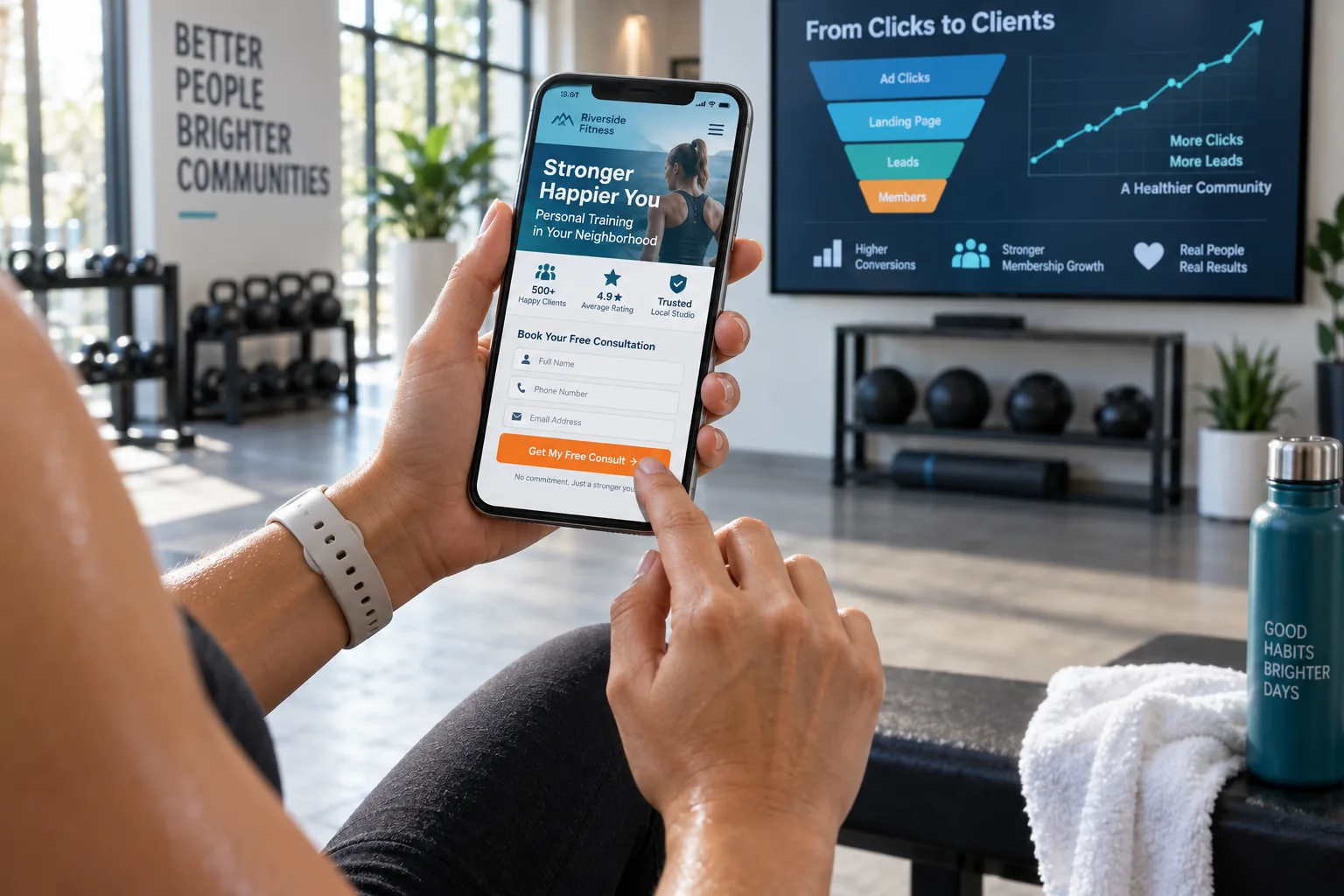
Landing page design and conversion analytics reviewed across desktop and mobile

Home   /   Digital Trends   /   PPC Landing Page Optimization

PAID SEARCH + POST-CLICK EXPERIENCE

PPC Landing Pages
That Turn Clicks Into Leads

A paid click is only the beginning. The landing page must continue the promise, remove friction, establish trust, and make the next step easy enough for a qualified visitor to take.

Written and technically reviewed by Maarit Durity
Published Jul. 9, 2026 · 13-minute read

THE SHORT ANSWER

PPC performance is won after the click as well as before it

PPC platforms can automate more targeting, bidding and creative decisions than ever before. They can identify patterns across searches, devices, locations and conversion signals faster than a person can adjust individual bids.

They cannot make a confusing landing page persuasive. They cannot repair a form that fails on mobile, prove an unsupported claim or make an irrelevant offer match the visitor’s need.

As ad platforms automate more of the auction, the post-click experience becomes one of the clearest competitive advantages an advertiser still controls directly. The landing page determines whether an expensive click becomes a qualified lead, an unqualified form submission or an immediate exit.

Google says its Performance Max campaigns automate bidding, targeting and creative optimization across its channels. It also says the system depends on strong data, meaningful conversion actions and quality creative inputs. See Google’s Performance Max lead-generation guidance.

The practical lesson is not that targeting no longer matters. It is that automation increases the cost of sending good traffic to a poor destination.

What the post-click experience includes

The post-click experience begins when the visitor taps the ad and continues until the business completes the intended next step.

A landing page can convert successfully and still produce poor business results if the form attracts the wrong people or the sales team never responds. Optimization must extend beyond the submit button.

It includes:

  • Page load and visual stability
  • Mobile layout
  • Match between the ad and page
  • Headline and offer
  • Service or product explanation
  • Proof and risk reduction
  • Form or checkout experience
  • Phone and booking options
  • Privacy and consent information
  • Thank-you page and confirmation
  • Sales response time
  • CRM routing and follow-up

Why automation makes landing pages more important

Google Smart Bidding uses auction-time signals such as device, location, time, language and audience context to adjust bids toward conversion goals. Performance Max can use keywordless targeting and information from the website and creative to find likely converters.

That creates three important consequences.

The platform learns from the conversion signal

If every form submission is treated as a success, the bidding system may find more people likely to submit forms—even when many are spam, job applicants, vendors or poor-fit prospects.

The advertiser must define the right success signal and return qualified-lead or sale information when possible.

The website becomes a targeting input

Automated systems may use landing-page content to understand the offer and match it to opportunities. Vague, outdated or overly broad pages can weaken that input.

Competitors have access to similar automation

Many advertisers can use the same bidding strategy and campaign type. They cannot use the same offer, expertise, proof, page experience and sales process unless the business gives them nothing original to compete against.

A four-part landing page framework

SoFloWeb evaluates PPC landing pages through four connected requirements.

Weakness in one area can waste strength in another. A fast page cannot rescue a misleading offer. Impressive proof cannot help when the visitor cannot find the form. A short form can create large volumes of poor leads when the promise is too broad.

Work through these points in order:

  1. Promise: The page immediately continues the specific promise made in the ad.
  2. Proof: The page gives the visitor credible reasons to believe the company can deliver.
  3. Path: The desired action is clear, proportionate and easy to complete.
  4. Performance: The page loads quickly, works on mobile, measures the right actions and supports follow-up.
A paid click becomes valuable only when the page completes the job
PROMISEMatch the ad and search intent

Carry the same service, location, offer, and expectation from the ad into the first screen.

CLARITYExplain the decision quickly

Show what is offered, who it fits, why the business is credible, and what the visitor should do next.

FRICTIONMake the next step practical

Use fast mobile delivery, readable content, useful forms, and contact options that fit the buying process.

QUALITYMeasure leads beyond the form

Connect conversion data with qualification, appointments, sales, and actual revenue instead of celebrating every submission.

Match the landing page to the ad promise

A visitor clicked because the ad created a specific expectation. The landing page should confirm that expectation immediately.

If an ad promotes emergency commercial roof repair, the page should not open with a general history of the roofing company. It should confirm commercial emergency service, eligible locations, response expectations and the next action.

Google’s landing-page optimization guidance recommends closely matching the landing page to the ad and keywords. If the page does not contain what the ad promised, visitors are more likely to leave.

Do not use one generic homepage for every campaign merely because it is convenient. A homepage serves many audiences and purposes. A PPC landing page should focus on the intent behind the click.

Message match includes:

  • The same service or product
  • The same offer or promotion
  • The same intended audience
  • The same geographic availability
  • Consistent pricing or eligibility language
  • A call to action that continues the ad

Give the visitor a clear first screen

Within the first mobile screen, the visitor should be able to understand:

Avoid opening with a slogan that could describe any business. “Solutions built for you” consumes valuable attention without confirming what the page offers.

A page can attract relevant traffic and still lose opportunities when its message, proof, form, or follow-up path is unclear.

A practical first-screen structure includes:

  • What the company offers
  • Whether it applies to the visitor
  • Where the service is available
  • Why the company is credible
  • What to do next

Review the elements below as one conversion path because strength in one area cannot fully repair a failure in another. Conversion performance depends on whether the visitor can understand the offer, trust the source, and complete the next step without friction. A page can attract relevant traffic and still lose opportunities when its message, proof, form, or follow-up path is unclear.

Review the following factors:

  • Specific headline
  • Short supporting explanation
  • Primary call to action
  • One meaningful trust element
  • Relevant image or visual proof

Build trust before asking for information

The more expensive, unfamiliar or high-risk the decision, the more proof the visitor needs.

Proof should match the advertised service. A general award may be less persuasive than a detailed example of the exact problem the visitor needs solved.

Do not use fake testimonials, invented counters or stock models presented as customers. Short-term conversion tactics that damage trust can create legal and reputational risk.

Useful trust evidence may include:

  • Relevant licensing and credentials
  • Years of applicable experience
  • Named experts
  • Verified reviews
  • Client or industry logos used with permission
  • Original project photographs
  • Case studies with context and limitations
  • Transparent process
  • Service guarantees the business can honor
  • Clear contact and location information
  • Privacy explanation
  • Professional associations

Create zero-friction conversion forms

Zero friction does not mean collecting no information. It means removing unnecessary effort, confusion and anxiety from the action.

Ask only what the next step requires

Every field should have a purpose. A first-contact form may need name, contact method, service need and location. It may not need a full mailing address, project budget, company history and detailed questionnaire before the business has earned the conversation.

Match form length to lead value and qualification needs

A short form can increase submission volume while reducing lead quality. A longer form can discourage casual inquiries while helping sales qualify complex work. Test the tradeoff rather than assuming fewer fields always wins.

Use clear field labels

Keep labels visible. Placeholder text that disappears while the visitor types can create errors. Explain format requirements before submission.

Support mobile input

Use appropriate keyboard types for email, phone and number fields. Make tap targets large enough. Avoid tiny checkboxes, date pickers that are difficult to operate and forms wider than the screen.

Explain what happens next

Tell the visitor whether the business will call, email, provide a quote, confirm an appointment or review eligibility. Include a realistic response window.

Preserve form entries after an error

Do not erase every field because one value was invalid. Point to the problem and preserve the rest of the work.

Provide an alternative path

Some visitors prefer to call, schedule or use chat. Show the most appropriate option without presenting so many equal choices that none feels clear.

Mobile speed is part of the sales experience

Paid visitors should not have to wait for oversized video, animation, tracking scripts and third-party widgets before they can read the offer.

Google’s website guidance recommends fast, responsive pages with important information and actions easy to find on small screens. Google also considers landing-page usefulness, relevance and navigation in ad quality and Ad Rank. See how the Google Ads auction works.

A staging page without analytics, call tracking, consent tools and chat widgets may appear fast while the live campaign page is not. Test the actual experience.

Improve speed by:

  • Compressing and properly sizing images
  • Using modern image formats where appropriate
  • Limiting third-party scripts
  • Loading nonessential media later
  • Avoiding autoplay background video on constrained devices
  • Using efficient hosting and caching
  • Reducing layout shifts
  • Removing unused plugins and code
  • Testing the real page with advertising tags active

Remove mobile conversion obstacles

Responsive design alone does not guarantee a useful mobile page.

Also test on a real phone using cellular data. A page that works on an office Wi-Fi connection and large monitor can fail in the customer’s environment.

Test whether a visitor can:

  • Read without zooming
  • Tap the phone number
  • Reach the form without hunting
  • Complete every field with one hand
  • Dismiss banners without blocking content
  • Use address and date fields
  • Understand error messages
  • Return from another application without losing progress
  • See the confirmation after submission

A MOBILE CLICK NEEDS AN EASY NEXT STEP

The visitor should be able to understand the offer, verify the business, and take the intended action without pinching, searching, or completing an unnecessarily long form. Mobile convenience is part of conversion quality, not a separate design concern.

Click or tap the image to enlarge it.

Use one primary conversion goal

Secondary actions can exist, but the layout should not force the visitor to choose among six unrelated next steps.

Match the action to the decision stage. Someone searching for emergency service may be ready to call. Someone comparing enterprise technology may need a detailed demonstration request. Someone researching a costly medical procedure may need educational content before scheduling.

Every landing page should have a clear primary action. That may be:

  • Request a quote
  • Schedule an appointment
  • Call now
  • Start an application
  • Purchase
  • Book a demonstration
  • Download a qualified resource

Design for qualified conversions

The cheapest lead is not always the best lead.

This information may reduce total submissions while improving sales efficiency. Hiding every limitation to maximize form volume transfers the cost to the staff handling unsuitable inquiries.

A landing page can improve qualification by stating:

  • Service area
  • Minimum project requirements
  • Customer type
  • Availability
  • Starting prices or cost factors when appropriate
  • Excluded services
  • Insurance or payment conditions
  • Required timeline

Measure the complete lead journey

The ad platform needs accurate conversion information, and the business needs to know whether those conversions became customers.

Google’s conversion measurement guidance explains that conversion actions can inform campaign optimization. It also warns that primary and secondary conversion settings matter because automated bidding relies on those signals.

If the campaign optimizes toward a thank-you-page view that can be reached without submitting, the system learns from false conversions. If every phone tap is counted as a lead regardless of whether the call connected, the report overstates performance.

Connect the CRM or offline conversion process when possible. The advertising system should learn the difference between a form submission and a closed, valuable customer.

At minimum, measure:

  • Landing-page visits
  • Form starts
  • Form completions
  • Click-to-call actions
  • Qualified call duration or outcome
  • Booking completion
  • Chat leads
  • Sales-qualified leads
  • Estimates or consultations
  • Closed sales and revenue

Protect privacy while measuring leads

Forms should collect only information the business can protect and use appropriately. Explain why sensitive information is requested. Use secure transmission, role-based access and reasonable retention policies.

Tracking and consent obligations vary by jurisdiction, platform and data type. Medical, financial, legal and children’s services can involve additional restrictions. A qualified privacy professional should review high-risk implementations.

Optimization does not justify collecting unnecessary personal information.

Test meaningful changes rather than random details

A useful landing-page test begins with a hypothesis.

Test one meaningful idea or a coherent page variant with enough traffic to evaluate it. Do not declare a winner after a handful of visitors.

Google Analytics defines an A/B test as a randomized experiment using multiple page variants and notes that GA4 requires integration with a third-party testing tool. See Google’s A/B testing explanation.

Statistical significance is not the only question. Confirm that the winning variant improves qualified leads or revenue, not merely button clicks.

Examples include:

  • A service-specific headline will improve qualified form completion compared with a general headline.
  • Showing the response process near the form will reduce abandonment.
  • Replacing a stock hero image with original project proof will improve consultation requests.
  • A two-step form will increase completion without reducing lead quality.
  • Showing cost factors will reduce unqualified inquiries and improve sales acceptance.

Use conversion economics to prioritize improvements

Landing-page optimization can create more value from the same media budget.

Imagine two campaigns each receive 1,000 paid visits at an average cost of $8 per click. Both spend $8,000.

The better page creates 20 additional leads without purchasing another click.

This is an illustration, not a forecast. Real lead quality, sales rate and revenue determine whether the improvement is valuable. A page that doubles low-quality submissions may increase operating costs instead of profit.

Review the following factors:

  • Page A converts 3 percent of visitors and produces 30 leads at approximately $267 per lead.
  • Page B converts 5 percent and produces 50 leads at $160 per lead.

Common landing page mistakes

Review the elements below as one conversion path because strength in one area cannot fully repair a failure in another. Conversion performance depends on whether the visitor can understand the offer, trust the source, and complete the next step without friction. A page can attract relevant traffic and still lose opportunities when its message, proof, form, or follow-up path is unclear.

Review the following factors:

  • Sending every ad to the homepage
  • Using a headline that does not match the ad
  • Hiding the service area
  • Asking for too much information too soon
  • Showing no proof before the form
  • Using tiny mobile controls
  • Allowing pop-ups to cover the call to action
  • Loading decorative media before essential content
  • Tracking button taps instead of completed outcomes
  • Counting spam and job inquiries as leads
  • Offering several competing calls to action
  • Removing navigation without providing needed trust information
  • Publishing unsupported urgency or scarcity
  • Failing to test forms after updates
  • Ignoring the thank-you and sales follow-up experience

A 30-day post-click improvement plan

Week one diagnose

Week one should identify where paid traffic is being lost before the team changes creative or increases spend. Tracking, message match, mobile behavior, and form delivery need to be tested together. The diagnosis creates the baseline for every repair and later experiment.

Review the work and evidence expected during this stage:

  • Confirm every ad destination.
  • Test pages on real mobile devices.
  • Verify conversion tracking.
  • Compare ad promise with page message.
  • Review call and form quality.
  • Identify the highest-spend weakest-converting pages.

Week two repair

Week two should correct the failures that can waste clicks regardless of campaign quality. Broken forms, unclear first screens, slow mobile behavior, and distracting pathways deserve attention before a nuanced test. These repairs give the next round of traffic a fair opportunity to convert.

Review the work and evidence expected during this stage:

  • Fix broken forms and tracking.
  • Improve mobile speed and layout.
  • Clarify the first screen.
  • Remove irrelevant distractions.
  • Add missing service-area and qualification information.

Week three strengthen

Week three should strengthen trust and reduce uncertainty around the conversion step. Proof, form guidance, call-to-action routing, and the thank-you experience all affect whether an inquiry is completed and handled correctly. The finished path should support both the visitor and the team receiving the lead.

Review the work and evidence expected during this stage:

  • Add relevant proof.
  • Improve form labels and error handling.
  • Connect calls to action to the correct workflow.
  • Build a complete thank-you experience.
  • Begin importing qualified outcomes when feasible.

Week four test

Thirty days can repair obvious waste and start a testing program. It is not enough to guarantee the final conversion rate.

Week four should test one documented hypothesis against the repaired baseline rather than changing several variables at once.

Review the work and evidence expected during this stage:

  • Select one high-value hypothesis.
  • Launch a controlled test.
  • Monitor lead quality as well as conversion rate.
  • Document the baseline and implementation date.

The SoFloWeb perspective

PPC management should not end at the edge of the advertising account. The ad, landing page, form, tracking and sales process operate as one system.

As targeting and bidding become more automated, businesses need to invest in the parts competitors cannot obtain by selecting the same campaign setting: a precise offer, real expertise, original proof, a fast mobile experience and a follow-up process that respects the lead.

SoFloWeb evaluates the post-click journey before recommending more media spend. Buying additional clicks for a page that is slow, vague or difficult to use is not scale. It is purchasing more opportunities to lose the customer.

PRACTICAL QUESTIONS

PPC Landing Page Questions

Straight answers about message match, mobile speed, forms, navigation, lead quality, measurement, and the role of AI in landing-page optimization.

CLEAR ANSWERS, USEFUL CONTEXT

These answers summarize the most common follow-up questions without replacing the details and qualifications explained throughout the article.

READ THE FULL ANSWER BEFORE MAKING THE DECISION

It is the process of improving the page and follow-up journey that paid visitors experience so more appropriate prospects complete a valuable action and become qualified customers.

Usually not when the campaign promotes a specific service, product, audience or offer. A focused landing page can continue the exact promise and remove unrelated choices.

Yes. Google evaluates landing-page relevance, usefulness and navigation as part of ad quality. Landing-page experience is also one of the components shown in the Quality Score diagnostic.

Only the fields needed for the next step and useful qualification. The correct number depends on the service, risk, sales process and value of the lead.

There is no universal rule. Removing unrelated navigation can increase focus, but high-consideration visitors may need access to credentials, policies and deeper information. Test a trustworthy focused experience rather than blindly removing links.

As quickly and reliably as practical on a real mobile connection. Measure the live page, including advertising and consent scripts, and prioritize usable content and controls rather than one perfect score.

AI can assist with analysis, variants and personalization, but the business remains responsible for accuracy, brand standards, privacy and customer experience. Automated tools cannot verify every claim or business outcome.

The most important metric is the business outcome closest to revenue, such as qualified leads, booked appointments or sales. Conversion rate and cost per lead need to be interpreted through lead quality.

Maarit Durity, owner of SoFloWeb

AUTHOR + TECHNICAL REVIEW

Maarit Durity

Owner, website strategist, designer, developer, SEO practitioner, and content strategist at SoFloWeb.

Maarit has worked in websites and digital marketing for more than 25 years. She writes from direct experience planning, building, rebuilding, optimizing, and measuring business websites—and takes responsibility for the technical review of this article.

Learn more about SoFloWeb and Maarit’s experience →