VIDEO CALL REQUEST

Choose a Time to Talk

Select an available 45-minute window, then tell us how to reach you. We will confirm the appointment and send the Google Meet details after reviewing the request.

45-minute video call. Times shown are Eastern. At least one day’s notice is required. Faded blocks are unavailable.

START A CONVERSATION

Tell Us What the Business Needs

Share the same project details requested on our homepage in two short steps. We will review the information and respond using the communication method you select.

ABOUT 2 MINUTESTwo focused steps
NO OBLIGATIONA practical first conversation
PERSONALIZED RESPONSEBased on the business and its goals
QUOTE & PROJECT DETAILS

Request a Website & Marketing Proposal

Tell us what the business needs, what is changing, and which services you are considering. We will review the details before recommending the clearest practical next step.

FOUR FOCUSED STEPSAbout 3 minutes
NO OBLIGATIONClear guidance without pressure
PERSONALIZED REVIEWBased on the business and its goals
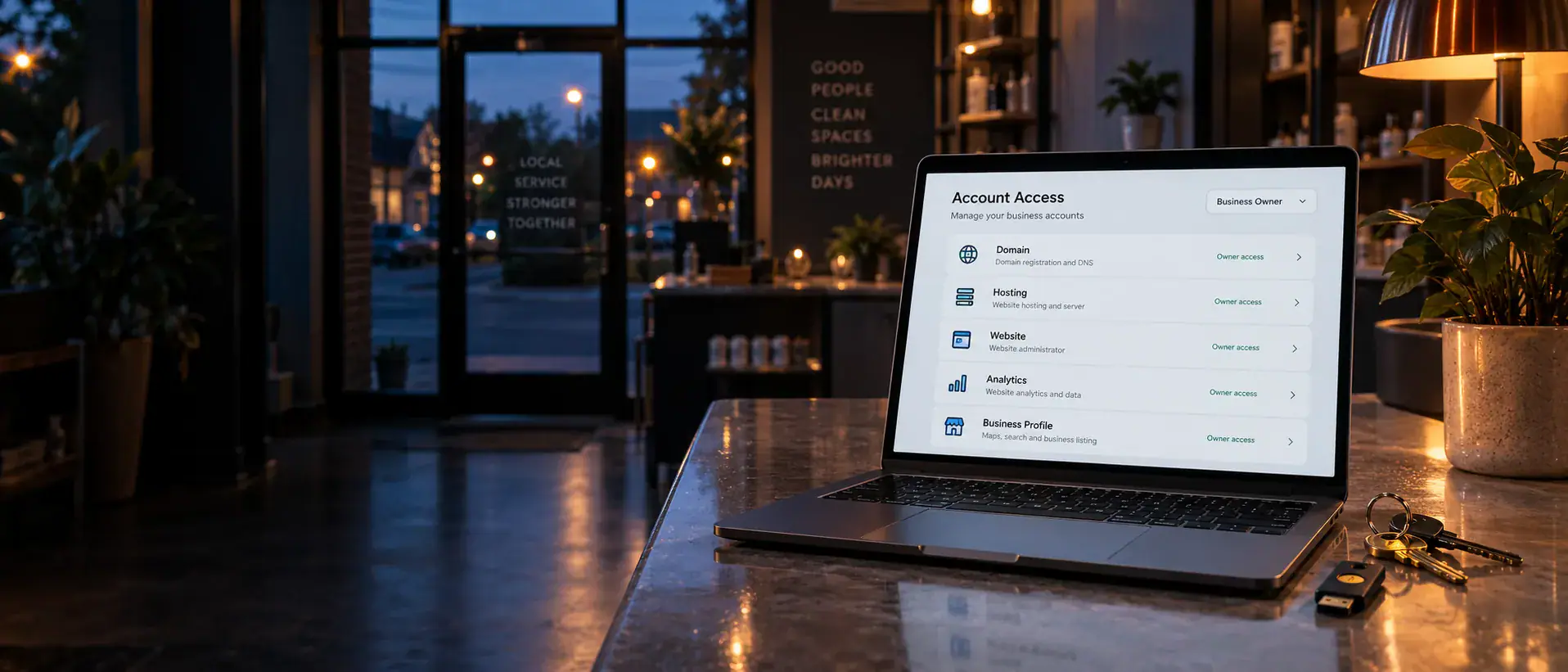
Business owner access to domain, hosting, website, analytics, and local profile accounts

Home   /   Digital Trends   /   Who Owns Your Website

WEBSITE OWNERSHIP + AGENCY TRANSITIONS

Who Owns Your Website
After Leaving an Agency?

Paying for a website does not automatically establish ownership of every asset or account. The contract, platform, licenses, registrations, access, and delivery terms determine what the business can actually take with it.

Written and technically reviewed by Maarit Durity
Published Sep. 10, 2026 · 14-minute read

THE SHORT ANSWER

The short answer depends on the contract

Paying an agency to build a website does not automatically prove that the client owns every part of it. Ownership depends on the contract, how the work was created, which third-party tools and media were used, and whose name appears on the domain, hosting and technology accounts.

This surprises business owners because the everyday assumption seems obvious: if a company paid for the website, the website should belong to the company. That is also how SoFloWeb believes a professional agency relationship should work. Our clients own the custom website design, copy and other original work we create for them once the agreed payment requirements are met. Their domain, hosting and essential business accounts are established under their name and information. We do not lease websites, and a client does not lose the website simply because the relationship ends.

Not every agency uses that model. Some sell access to a hosted website service rather than ownership of a portable website. Others transfer the visible content but retain the template, system or code needed to operate it. A few provide a nominally portable WordPress website that becomes extremely difficult for another company to maintain.

The only safe answer is the one supported by the written agreement and the actual account setup.

This article provides general educational information, not legal advice. A business with a disputed contract or valuable intellectual property should have a qualified attorney review the agreement.

Paying for a website is not the same as receiving its copyright

The U.S. Copyright Office explains that copyright initially belongs to the author or authors of a protected work. A transfer of copyright ownership generally must be documented in writing and signed by the party transferring the rights. See the Copyright Office guidance on copyright ownership and transfer and copyright assignments.

That distinction matters when an independent agency, designer, developer, photographer or copywriter creates work for a client. The fact that the client paid an invoice may establish permission to use the completed work, but it does not necessarily answer whether the client received the copyright, an exclusive license, a nonexclusive license or access only during the service term.

A strong agreement should say what happens to each deliverable after final payment and after termination. Vague phrases such as “website included” or “full-service website” do not answer that question.

Website ownership includes more than the design

A website is not one item. It is a collection of assets, accounts, licenses and infrastructure. A business can own one layer and remain dependent on an agency for another.

A promise that “you own the website” is incomplete if the agency still controls the domain, hosting, administrator account or technology needed to run it.

Our companion guide, Who Should Own Your Website and Marketing Accounts?, provides a platform-by-platform access checklist for domains, hosting, WordPress, Search Console, analytics, Business Profile, advertising, and lead data.

The ownership conversation should cover:

  • Domain registration
  • DNS records
  • Hosting account
  • Website files and database
  • Custom theme or template work
  • Custom code and integrations
  • Written copy and downloadable files
  • Logos and original graphics
  • Original photographs and videos
  • Stock media licenses
  • Fonts, themes and plugin licenses
  • Analytics and tag-management accounts
  • Search Console and Business Profile access
  • Advertising, email and social accounts
  • Form submissions and customer data
  • Design source files
  • Code repositories and build instructions
  • Backup archives and staging environments

OWNERSHIP SHOULD BE TRANSFERABLE AND VERIFIABLE

The business should be able to access its domain, hosting, website, analytics, advertising, and local profiles without depending on a former provider. Named access, multi-factor authentication, and a documented handoff reduce disruption when responsibilities change.

Click or tap the image to enlarge it.

The domain should be registered to the business

The domain is the address customers know and search engines associate with the company. Losing control of it can interrupt the website, email, advertising and brand reputation at the same time.

ICANN describes the registrant as the individual or entity that registers a domain and enters into the registration agreement. Its information for domain registrants explains that registrants have rights and responsibilities involving management, transfer and renewal.

The business should be listed as the registrant and should control the registrar account, primary email address, recovery information and multifactor authentication. An agency can be granted technical access without becoming the only party able to renew or transfer the name.

An agency should not use control of the domain as leverage to stop a client from leaving.

Red flags include:

  • The domain is registered in an agency employee’s personal name.
  • The business cannot sign in to the registrar.
  • The recovery email belongs only to the agency.
  • The business does not receive renewal notices.
  • The agency refuses to identify the registrar.
  • The domain transfer depends on paying an unexpected release fee.
Website control is divided across assets, accounts, rights, and access
REGISTRATIONDomain and account ownership

The business should know whose name controls the registrar, hosting, analytics, and other essential accounts.

DELIVERABLESFiles, database, copy, and media

Contracts should identify what is delivered, what is licensed, and what remains owned by a provider or third party.

PORTABILITYAbility to move and continue

A usable handoff requires adequate rights, administrator access, compatible files, credentials, and documentation.

SEARCH EQUITYPreserve URLs and proven content

A planned transition protects valuable pages, redirects, metadata, tracking, and established visibility.

Hosting should not become a hostage situation

Managed hosting can be valuable. The problem is not that an agency manages the server; the problem is when the business has no contractual right or practical ability to obtain a complete backup and move.

The contract should state how long the agency will keep the site active after cancellation, when access ends, what export will be provided and whether transition assistance has an hourly cost.

A portable website handoff normally includes:

  • All website files
  • A current database export
  • Media uploads
  • Configuration details needed for migration
  • DNS records or access to reproduce them
  • Redirect rules
  • SSL and security considerations
  • Scheduled tasks and integration details
  • A list of required technology and licenses
  • Reasonable cooperation during the transition

A website lease can disappear when payments stop

In a leased or subscription website model, the monthly payment purchases continued access to a service. It may include design, hosting, maintenance, technology and marketing support. When the subscription ends, the website may be disabled and the client may retain only the materials it supplied—or whatever limited assets the agreement specifically allows it to keep.

The model can offer a lower initial expense, bundled maintenance and less technical responsibility. Those benefits can be reasonable for a business that knowingly chooses a subscription and understands the exit terms.

Leasing is not automatically deceptive. The danger is entering the arrangement without understanding that the monthly charge may not purchase ownership.

The disadvantages are more serious when the arrangement is presented as though the client is buying a website:

  • Years of payments may build no portable website asset.
  • Leaving can require a complete rebuild.
  • URLs and search equity may be lost during a rushed transition.
  • Custom content may be licensed only during the service term.
  • The business may not control hosting or source files.
  • Forms, call tracking and lead history may be trapped in the vendor’s system.
  • A new agency may be unable to begin until the old service releases accounts.
  • The subscription may cost more over time than an owned website.
  • A cancellation dispute can interrupt the company’s primary source of leads.

Industries Where Rented or Leased Websites Are Common

Rented website arrangements are especially common when the site is bundled with a larger monthly package that includes hosting, industry data, lead tracking, booking tools, inventory feeds, compliance features, advertising, or ongoing marketing. The business may be paying for access to the provider’s complete system rather than purchasing a website that can be moved intact.

That does not mean every website serving these industries is leased. The contract, account ownership, administrator access, export options, licensing, and cancellation terms determine whether the business is building a transferable asset.

These arrangements can be practical when the business knowingly chooses a subscription and values the included tools. The problem begins when the buyer believes the monthly payments are building ownership, only to learn during cancellation that the website, design, platform, or supporting accounts cannot leave with the business.

Review the following factors:

  • Automotive dealerships and vehicle businesses. Dealer websites may depend on inventory feeds, financing tools, customer-management integrations, call tracking, and manufacturer programs controlled through the website provider.
  • Real estate brokerages, agents, and property companies. IDX feeds, listing displays, lead routing, agent profiles, and customer-management tools are often delivered through subscription platforms that may not provide a portable website.
  • Home-service companies and skilled trades. Plumbers, HVAC companies, roofers, remodelers, landscapers, pest-control companies, and similar businesses are frequently sold monthly packages combining a templated website, call tracking, lead management, advertising, and hosting.
  • Medical, dental, legal, and professional practices. Industry-focused marketing packages may combine hosting, intake forms, tracking numbers, licensed content, and provider-controlled templates under one recurring agreement.
  • Restaurants and hospitality businesses, fitness businesses, and appointment-based businesses. Ordering, reservations, menus, scheduling, memberships, gift cards, and payment functions may operate inside a provider’s platform rather than a website the business can move independently.
  • Franchises and multi-location companies. A franchisor or approved vendor may control the main platform, brand templates, location pages, forms, and shared content while individual operators pay for access and local features.
  • Mortgage, insurance, and financial-service businesses. Compliance libraries, calculators, application tools, rate or product feeds, and required disclosures may be tied to a provider-controlled website system.
  • Small-business starter packages across many industries. Low-entry-cost website offers sometimes spread setup and development costs across a long monthly agreement, with continued payment required to keep the site active.

Questions to ask before signing a website agreement

Do not settle for “of course you own it.” Ask the agency to put the answer in writing.

Ownership questions

Ownership questions should be documented clearly enough that another qualified person can understand the responsibility without relying on a sales conversation. Written answers make competing proposals easier to compare and expose exclusions that may affect cost, control, or continuity later. A confident promise is not a substitute for a defined deliverable, named owner, and practical handoff path.

Ask and document the following:

  • Who owns the custom design after final payment?
  • Who owns the written copy?
  • Who owns custom graphics, code, photographs and video?
  • Is copyright assigned to the client or merely licensed?
  • Does the license continue permanently after cancellation?
  • Which components cannot be transferred because they are third-party assets?
  • Can the client modify the work or hire someone else to modify it?

Account questions

Written answers make competing proposals easier to compare and expose exclusions that may affect cost, control, or continuity later. A confident promise is not a substitute for a defined deliverable, named owner, and practical handoff path. Account questions should be documented clearly enough that another qualified person can understand the responsibility without relying on a sales conversation.

Ask and document the following:

  • Whose legal name is on the domain registration?
  • Who controls the registrar, DNS and hosting accounts?
  • Will the client have administrator access from the beginning?
  • Are Analytics, Search Console, advertising and Business Profile accounts created under the client’s organization?
  • Who owns form submissions, CRM records and call-tracking data?

Exit questions

If the salesperson cannot answer these questions, ask for someone who can. If the written contract contradicts the sales explanation, the contract is the warning.

A confident promise is not a substitute for a defined deliverable, named owner, and practical handoff path.

Ask and document the following:

  • What exactly will the client receive when the agreement ends?
  • Will the agency provide files and a database export?
  • Will the website continue working outside the agency’s hosting?
  • How long is the transition period?
  • Are there export, migration or release fees?
  • What happens to licensed plugins, fonts and stock media?
  • Will the agency assist the new provider?
  • Can the domain and email remain operational throughout the move?

Third-party components require accurate ownership language

Even when a client owns all custom work, the website may contain components that no agency can transfer as exclusive property.

WordPress and open-source technology

WordPress is distributed under the GPL. The client does not exclusively own WordPress itself. The business should, however, receive its website files, database, configuration and the rights granted under the applicable open-source licenses. WordPress explains its licensing position on the WordPress license page.

Commercial themes and plugins

Some licenses can be transferred to a client account. Others remain tied to an agency plan and require the client to purchase a replacement license for updates or support. The contract should identify which applies.

The site should not break simply because an agency license expires. However, updates, templates, cloud features or support may stop. Those dependencies need to be disclosed before the handoff.

Stock photographs and video

Stock media is licensed, not sold as exclusive copyright. The client’s continued use depends on the license acquired for the project. The agency should keep proof of licensing and explain whether the license covers the client after the relationship ends.

Fonts

Desktop, web and application font licenses can have different rules. A font file should not be handed over if the license prohibits transfer. The client may need its own license even though the visual design belongs to the client.

Technology as a Service

Forms, chat, booking, email delivery, accessibility tools, analytics and other functions may rely on subscriptions. The website can be owned while those services remain licensed. Each important service should be in a client-controlled account or have a documented transition plan.

WordPress does not automatically prevent agency lock-in

WordPress is portable in principle, but an agency can still build a WordPress site that is unnecessarily difficult for someone else to edit or migrate.

Common forms of technical lock-in include:

Restricting administrator access

The client receives an editor login but not a true administrator account. The agency remains the only party able to install plugins, create users, export data or change critical settings.

Using an agency-only theme or builder

The visible pages depend on a proprietary theme, custom builder or cloud library that is not included in the handoff. When the agency license is removed, layouts may lose features or become difficult to change.

Hard-coding ordinary content

Headings, phone numbers, services and calls to action are placed directly in theme files rather than editable fields. A new provider must modify code for changes that should be manageable in the content system.

Hiding core functionality in a custom plugin

Forms, content types, redirects, schema, location data or integrations are controlled by a custom plugin that is omitted, disabled remotely or undocumented during transfer.

Creating undocumented dependencies

The site relies on an external API, agency server, private code repository, build process or deployment key that the client cannot access. A future developer sees the finished output but not the system needed to maintain it.

Retaining premium licenses without disclosure

The website uses premium plugins or fonts under an agency account, but the client is never told which replacement licenses will be required. Updates and security fixes may stop after the relationship ends.

Making the database difficult to reuse

Some page builders store content in complex proprietary structures. That is not automatically improper, but it can make migration to another builder expensive. The agency should disclose the major tools and give the client a working site, not merely a folder of files that cannot be operated.

Failing to provide source files

The website contains compiled CSS or JavaScript, but the editable source, build configuration and design files are withheld. Another team can keep the current site online but cannot efficiently revise it.

Controlling DNS email and analytics together

The most dangerous lock-in is operational rather than visual. If one vendor account controls the domain, DNS, website, business email, analytics and advertising, a dispute can affect the entire company at once.

Not every complicated website is intentionally restrictive. Custom systems can require specialized knowledge. The test is whether the agency documented the system, disclosed dependencies, provided appropriate access and created a reasonable path for another qualified professional to continue the work.

What a complete website handoff should include

A responsible handoff should be planned, not improvised on the last day.

Passwords should be transferred securely and then changed. Former agency access should be removed only after the new team confirms that the site, email, DNS and tracking remain functional.

The package may include:

  • Domain registrar and DNS access
  • Hosting ownership or migration credentials
  • Full website files and database
  • Current backups
  • Administrator accounts
  • Theme and child-theme files
  • Custom plugins and code
  • Design source files included in the agreement
  • Original copy and approved content files
  • Original media and stock-license records
  • Redirect list
  • Analytics and tag-manager access
  • Search Console and Business Profile access
  • Advertising-platform access
  • Form and CRM export
  • Integration inventory
  • API ownership and renewal information
  • Plugin, theme and font license list
  • Security and maintenance notes
  • Staging and deployment documentation
  • Renewal calendar for domains and subscriptions

What to do if the agency already controls everything

Do not begin by threatening to cancel. First, quietly document the current environment.

Preserving URLs is especially important. If a leased website must be rebuilt, map every valuable old URL to the most relevant new page. A migration without redirects can discard years of links, bookmarks and search visibility.

Work through these points in order:

  1. Locate the signed contract, order form and incorporated terms.
  2. Identify the domain registrar and named registrant.
  3. Inventory hosting, DNS, email, website, analytics, advertising and social accounts.
  4. Confirm the access level the business currently has.
  5. Download data and backups where the agreement and permissions allow.
  6. Record all recurring subscriptions and renewal dates.
  7. Ask the provider for its written cancellation and export process.
  8. Have a qualified developer evaluate portability before setting a cancellation date.
  9. Have an attorney review disputed ownership or release terms when necessary.
  10. Build the replacement and redirect plan before the old service ends.

The SoFloWeb ownership standard

SoFloWeb clients own the custom work we create for them. Domains, hosting and essential business accounts are set up under the client’s name and information, with the client retaining control. We do not lease websites or require a client to keep paying us to preserve the existence of work that was purchased.

If a client decides to work with another company, the website should be able to go with the client. We provide the access and transferable materials needed for a professional transition. We do not deliberately disable editing, withhold administrator rights or construct a WordPress site to punish the business for leaving.

Third-party technology, fonts and stock assets remain subject to their licenses, and ongoing services still require hosting and maintenance. Those are normal operating realities. They should be disclosed clearly rather than used to disguise agency lock-in.

Our view is simple: a business that pays for a custom website should be building an asset for the business—not increasing the agency’s leverage over it.

PRACTICAL QUESTIONS

Website Ownership Questions

Practical answers about domains, hosting, website files, databases, code, copy, images, licenses, administrator access, portability, and SEO during an agency transition.

CLEAR ANSWERS, USEFUL CONTEXT

These answers summarize the most common follow-up questions without replacing the details and qualifications explained throughout the article.

READ THE FULL ANSWER BEFORE MAKING THE DECISION

Not necessarily. Payment alone may not transfer copyright or ownership of every component. The agreement should identify the work being transferred, any continuing licenses and the client’s rights after cancellation.

An agency may own or control parts of a website if the contract establishes a subscription, limited license or provider-owned system. Whether a particular agency is entitled to withhold files is a contract-specific legal question.

Check the registrar account and registrant information. The safest arrangement is for the business to be the registrant and control the account. Paying an agency for registration does not by itself confirm whose name was used.

An owned, portable website usually can be moved, but third-party platform restrictions, missing files, incompatible server requirements or contract terms can complicate the process. Test portability before ending the current service.

The contract should transfer ownership or grant a permanent license. Without clear written terms, commissioned copy may remain owned by its author or agency. Stock and syndicated content may have separate restrictions.

WordPress core and many themes and plugins use open-source licenses. Custom code ownership and licensing depend on the agreement and applicable licenses. The client should receive the site files, database and right to continue operating the website.

It should be possible when the client has adequate rights, administrator access, files, licenses and documentation. A technical audit can identify proprietary tools or undocumented dependencies before a takeover.

If the site disappears or is rebuilt without preserving URLs, content and redirects, rankings and organic traffic can decline. A planned migration can preserve much of the existing value, but no agency can guarantee unchanged rankings.

Maarit Durity, owner of SoFloWeb

AUTHOR + TECHNICAL REVIEW

Maarit Durity

Owner, website strategist, designer, developer, SEO practitioner, and content strategist at SoFloWeb.

Maarit has worked in websites and digital marketing for more than 25 years. She writes from direct experience planning, building, rebuilding, optimizing, and measuring business websites—and takes responsibility for the technical review of this article.

Learn more about SoFloWeb and Maarit’s experience →